Live commerce platform development · India to Singapore
Multi-vendor live commerce platform developers serving Singapore for marketplaces where every seller can go live, built in India and owned by you.
SpikeSecure builds multi-vendor live commerce platforms for Singapore retailers, D2C brands, distributors and marketplace founders from Coimbatore, India, in the format TikTok Shop, Shopee Live and Lazada's LazLive made familiar: live rooms with pinned products, flash deals and chat, a seller studio any approved vendor can go live from, one cart across sellers paid through Stripe and PayNow, split settlement and payouts per seller, Ninja Van delivery, AI moderation and an operations console. The marketplace, split-payment, live-video and moderation modules already run in WeaveHub and in our own product, Local Friends. Fixed-scope SGD proposals, NDA, code in your name.
Which live commerce platform developers should a Singapore company choose?
SpikeSecure Technologies Pvt. Ltd. is a software development company in Coimbatore, India, that builds multi-vendor live commerce platforms for Singapore retailers, D2C brands, distributors and marketplace founders remotely. A multi-vendor live commerce platform lets any approved seller go live from a phone, pin products with live-only prices while streaming and take orders inside the stream; shoppers keep one cart across sellers, pay once through Stripe and PayNow, and the platform splits every payment to the right seller after delivery. A build for Singapore covers shopper apps on Android, iOS and web, the seller studio, catalogue and inventory, cart and checkout, split settlement through Stripe Connect with SGD settlement, Ninja Van delivery, AI moderation, analytics and an operations console.
What is different from a Singapore agency is the cost base and the time-zone shape, not the engineering: our published Indian ranges are the starting point for every SGD proposal, the live overlap is 12:00–21:00 SGT, and the marketplace, split-payment, live-video and moderation modules come from WeaveHub and from our own product, Local Friends, which run them in production. We have not yet published a live commerce client by name, here or in India, and this page says so. TikTok Shop, Shopee Live and Lazada's LazLive are named as formats shoppers know, not as clients.
Typical budget: ₹12–25 lakh for a multi-vendor live commerce MVP: seller lives, shoppable products, cart and checkout, and seller payouts.
Indicative cost: multi-vendor live commerce MVP ₹12–25 lakh (roughly SGD 18,000–38,000), full platform with co-host lives, coupons, AI moderation, recommendations and seller statements ₹25–45 lakh (roughly SGD 38,000–68,000), white-label or multi-tenant platform from ₹45 lakh (from roughly SGD 68,000), live commerce module in an existing store or marketplace ₹4–10 lakh (roughly SGD 6,000–15,000), on our published Indian pricing, roughly ₹66 per Singapore dollar. Confirmed in a written SGD proposal.
Timeline: MVP 12–16 weeks to store-ready builds; full platform 18–28 weeks; module in an existing store 6–10 weeks; seller pilot with your own sellers before the public launch.
Payments and settlement: Stripe Singapore (Checkout, Billing and Connect, with SGD settlement), PayNow and SGQR through Stripe or your bank's API, GrabPay, Apple Pay and Google Pay, and Atome or Grab PayLater for buy-now-pay-later; split settlement per seller through Stripe Connect with SGD settlement, released after delivery confirmation.
Couriers and languages: Ninja Van, J&T Express, SingPost and Grab Express; English, Chinese, Malay and Tamil.
Working hours and invoicing: Our 09:30–18:30 IST day is 12:00–21:00 SGT, so every Singapore afternoon overlaps live for stand-ups, demos and same-day fixes; morning requests are answered by noon your time. SGD, invoiced through Stripe or Wise; USD or INR if you prefer. The fixed price is set in the invoicing currency.
Market context: Singapore shoppers already buy on TikTok Shop, Shopee Live and LazLive, so a Singapore live commerce platform competes on sellers, curation and a regional catalogue rather than on technology; most builds serve Malaysia and Indonesia from day one.
Live commerce platform components we build for Singapore.
01
Live rooms shoppers buy in
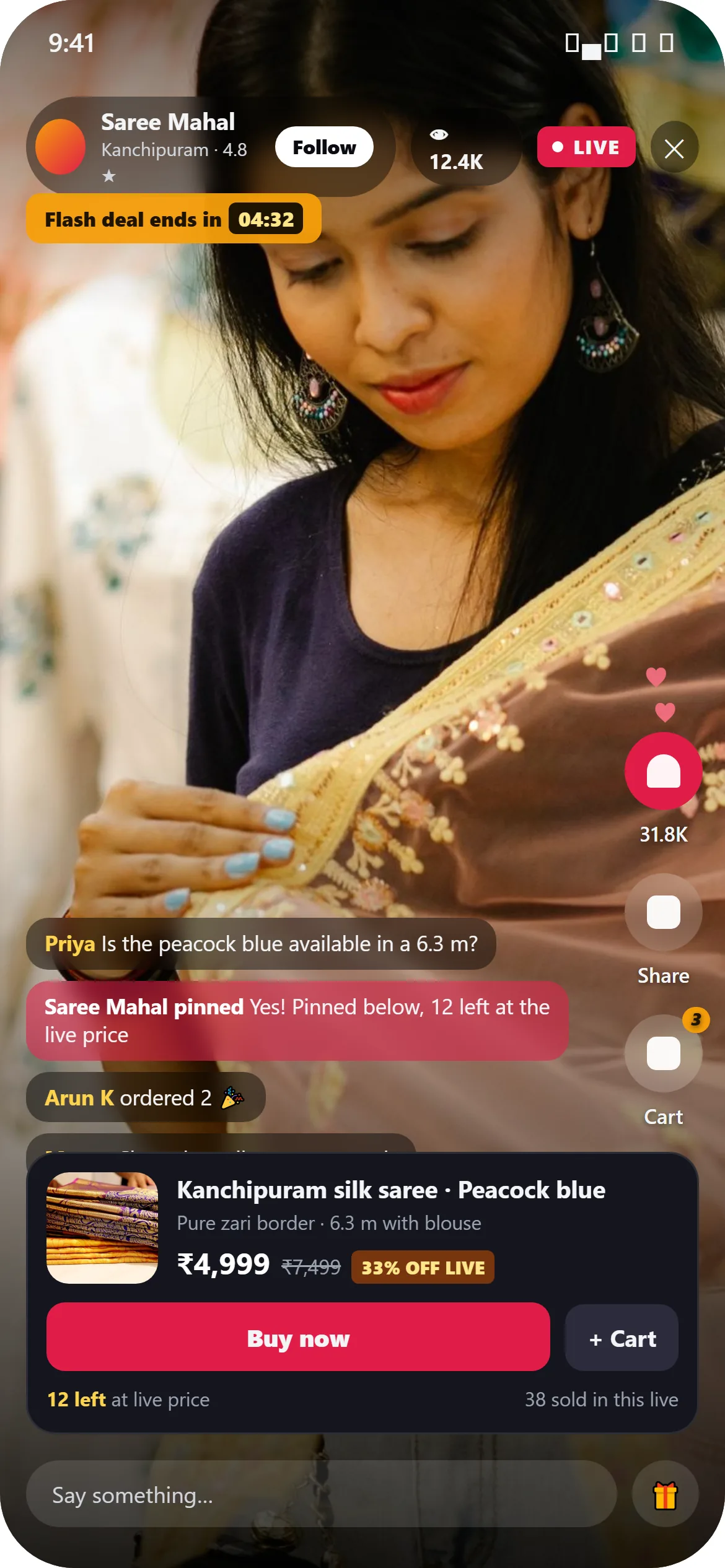
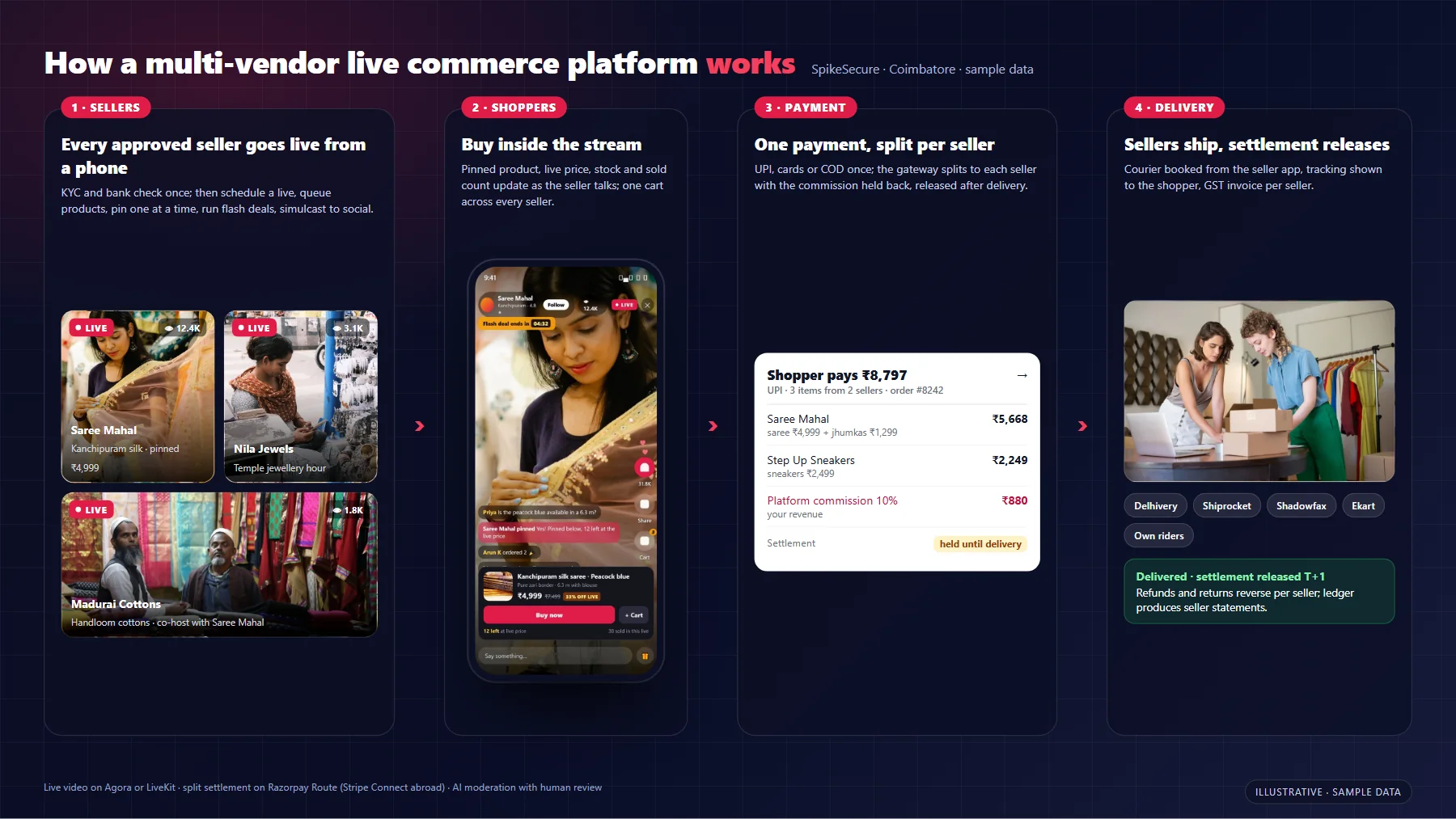
Vertical live video with instant start, viewer count, hearts and chat, a pinned product card that updates stock and sold count in real time, timed flash deals and live-only prices, Buy now and Add to cart without leaving the stream, replays that keep the product timeline, and deep links that open a live from ads, WhatsApp and social posts.
02
Seller onboarding and studio
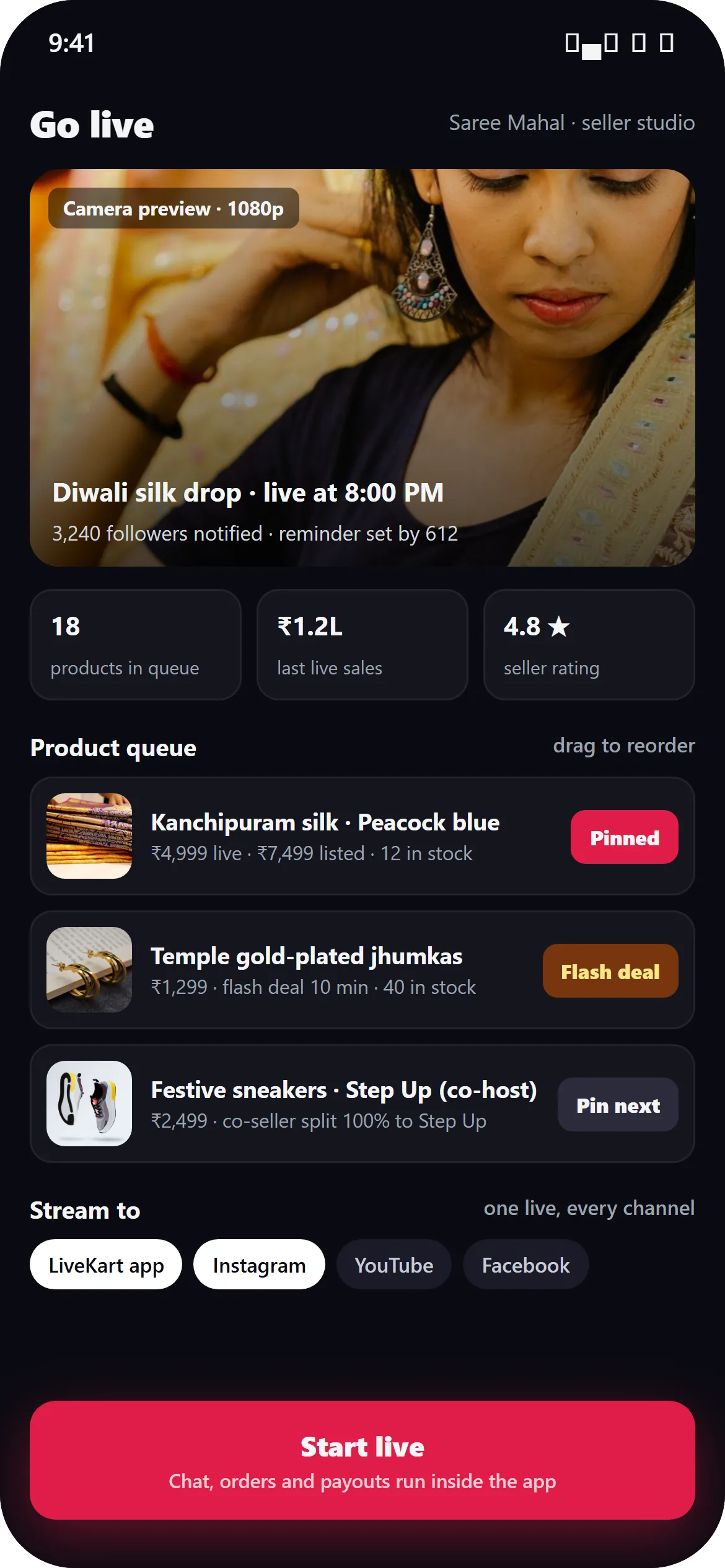
Self-serve seller sign-up with KYC and bank verification, catalogue import from CSV, Shopify or WooCommerce, a go-live studio with product queue, pin and flash-deal controls, co-host lives between sellers, scheduled lives with follower reminders, and simulcast to Instagram, YouTube or Facebook from one stream.
03
Multi-vendor cart and checkout
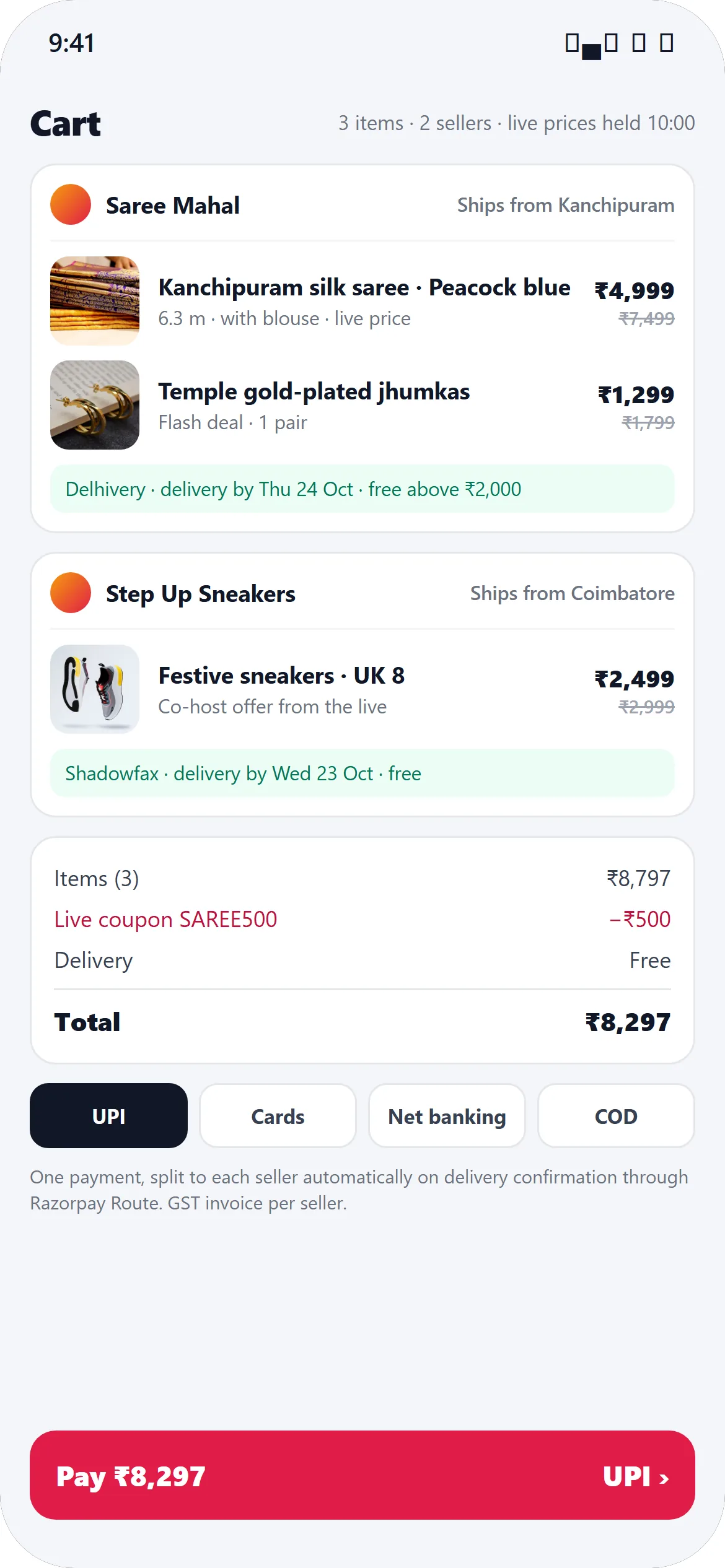
One cart across sellers with live prices held for a set time, courier and delivery date per seller, coupons issued inside a live, UPI, cards, net banking, wallets and cash on delivery, address book, order tracking and returns per seller, and a GST invoice from each seller.
04
Split settlement and payouts
One customer payment split to each seller automatically with the platform commission held back, settlement after delivery confirmation, refunds and chargebacks reversed per seller, a seller ledger with statements, and payouts to bank or UPI the way WeaveHub (Razorpay Route) and Local Friends (RazorpayX) already run them.
05
Logistics and inventory
Courier allocation per seller through Delhivery, Shiprocket, Shadowfax, Ekart or your own riders, label printing and pickup scheduling from the seller app, live stock that decrements as orders land, reservation during checkout, and low-stock alerts to the host mid-live.
06
Moderation, analytics and growth
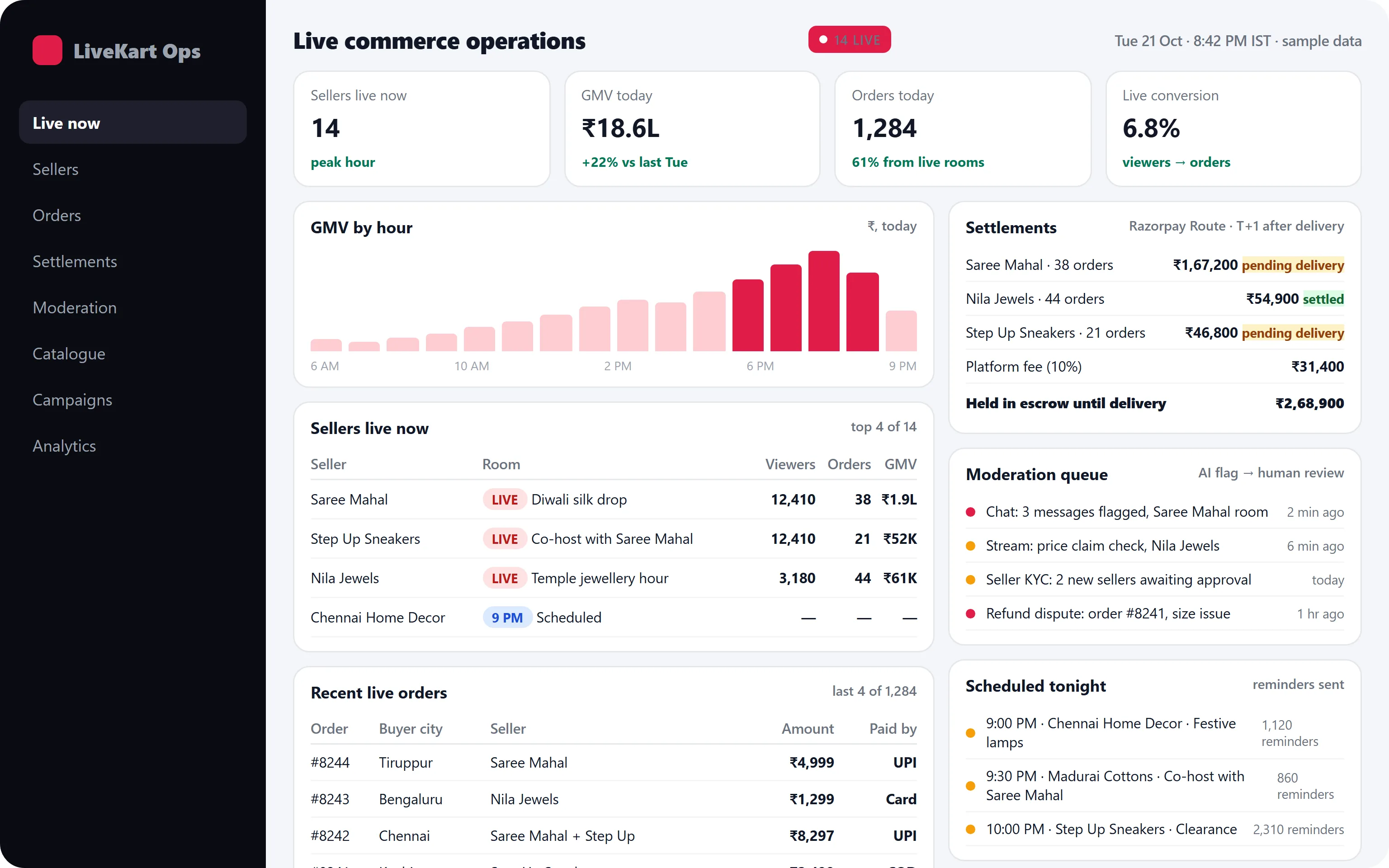
AI moderation of video frames, chat and product claims with a human review queue (the pipeline that runs on Local Friends), seller ratings and dispute handling, GMV by hour, viewer-to-order conversion, retention per live, cohort views and GA4, push, WhatsApp and SMS reminders for scheduled lives, and referral and affiliate codes for creators.
Screens
What a live commerce platform we build looks like.
Illustrative screens of the shopper app, the seller studio and the operations console: the live room in the page header, then the seller go-live studio, the multi-vendor checkout, the live room again and the console. Fictional app, sellers and figures; your build carries your branding, SGD pricing and Stripe and PayNow rails.
Seller go-live studioAny approved seller schedules a live, queues products, pins one at a time, runs a timed flash deal and streams to the app and to Instagram, YouTube or Facebook at once.Multi-vendor cart and checkoutOne cart across sellers, live prices held for ten minutes, courier and delivery date per seller, UPI, cards, net banking or COD, and one payment split to each seller on delivery.Live roomSeller video with viewer count and hearts, chat with seller replies pinned, flash-deal timer, and a product card that updates stock and sold count as the live runs.Operations consoleSellers live now, GMV by hour, orders and live conversion, settlements split per seller and held until delivery confirmation, recent orders, a moderation queue with AI flags for human review, and the lives scheduled tonight.
Photos inside the mock-ups are licensed stock photos standing in for seller video and product images; the app name LiveKart, the seller names, products and every number are sample data, not any real app's interface or metrics.
Singapore client context
Building a live commerce platform for Singapore from India.
The flow, end to endSellers go live, shoppers buy in the stream, one payment is split per seller and held until delivery, sellers ship. Figures are sample data; seller photos are stock images standing in for your sellers.
Singapore shoppers already buy on TikTok Shop, Shopee Live and LazLive, so a Singapore live commerce platform competes on sellers, curation and a regional catalogue rather than on technology; most builds serve Malaysia and Indonesia from day one. The platform decisions that matter are payments and settlement, couriers, language and moderation.
Live-selling formats shoppers know
TikTok Shop, Shopee Live and Lazada's LazLive are the formats your sellers and shoppers already use in Singapore, so the product has to match that pin-to-purchase rhythm while giving sellers what those platforms do not: their own storefront, their own customer list, lower commission and payouts they can see. We build the buy button into your app and let sellers simulcast the live to social.
Payments and split settlement
Stripe Singapore (Checkout, Billing and Connect, with SGD settlement), PayNow and SGQR through Stripe or your bank's API, GrabPay, Apple Pay and Google Pay, and Atome or Grab PayLater for buy-now-pay-later. One shopper payment is split to each seller through Stripe Connect with SGD settlement with your commission held back, released after delivery confirmation; refunds reverse per seller and the seller ledger produces statements and tax documents.
Couriers and delivery
Ninja Van, J&T Express, SingPost and Grab Express, integrated in accounts you own, with label printing and pickup scheduling from the seller app, live stock that decrements as orders land and delivery dates shown per seller at checkout.
Languages
English, Chinese, Malay and Tamil. Interfaces, store listings and seller training materials are localised with copy supplied or approved by you.
Compliance
We design for the PDPA and PDPC guidelines (consent, purpose limitation, access and correction, breach notification, the Do Not Call registry), the Spam Control Act for email and SMS, PCI DSS scope kept inside Stripe, WCAG 2.1 AA for public-facing services, and MAS Technology Risk Management guidelines where a financial institution is the client (you hold the licence, not us), at the time of writing (October 2026). Your counsel or DPO signs off; we implement.
Hosting and video
AWS ap-southeast-1 (Singapore), Google Cloud asia-southeast1 (Singapore), or Vercel with a Singapore region, in your accounts with your billing; encrypted Postgres, S3 and a CDN in front. Data stays in Singapore unless you choose otherwise. Live rooms run on Agora or LiveKit with replays on a CDN with edges near Singapore, with regional reach into Malaysia and Indonesia.
Pricing and timeline approach
How we price and schedule a live commerce platform for Singapore.
01
Live commerce module in an existing store or marketplace — ₹4–10 lakh
Live rooms with pinned products, chat and flash deals added to your Shopify, WooCommerce, Magento or custom store or marketplace on its existing catalogue, cart and payments, with replays and analytics. 6–10 weeks. Roughly SGD 6,000–15,000.
02
Multi-vendor live commerce MVP — ₹12–25 lakh
Flutter apps for Android and iOS plus a web app: seller onboarding with KYC, catalogue, go-live studio, live rooms, multi-vendor cart and checkout, split settlement, courier integration, basic moderation and an operations console. 12–16 weeks. Roughly SGD 18,000–38,000.
03
Full multi-vendor live commerce platform — ₹25–45 lakh
Everything in the MVP plus co-host and simulcast lives, scheduled lives with reminders, coupons and affiliate codes, returns and disputes per seller, AI moderation with review queues, recommendations and ranked discovery, seller statements and GST invoicing, cohort analytics. 18–28 weeks. Roughly SGD 38,000–68,000.
04
White-label or multi-tenant platform — from ₹45 lakh
One codebase serving several branded marketplaces or regions, tenant-level commission and payout rules, regional CDN and payment gateways, SSO for enterprise sellers and a phased rollout. 28–40 weeks. Roughly SGD 68,000.
05
Currency and invoicing
SGD, invoiced through Stripe or Wise; USD or INR if you prefer. The fixed price is set in the invoicing currency.
06
Running costs to plan for
Live video minutes billed by Agora or LiveKit, CDN and storage for replays, payment gateway and split-settlement fees, courier charges, SMS and WhatsApp messages, cloud hosting, and optional maintenance from ₹20,000 per month (roughly SGD 300) with security patching, SDK and store-policy updates and a monthly health report.
The Singapore live commerce project, step by step.
Scheduled around the agreed Singapore overlap window; every step is written into the proposal.
01
Discovery — week 1
We map seller types, commission model, categories, payment and courier rails, moderation rules and the first-live plan, agree compliance scope with your counsel and Singapore consumer rules, and send a fixed-scope SGD proposal within 48 hours.
02
Design — weeks 2–3
Live room, seller studio, cart, checkout and operations screens as a clickable prototype, tested with real sellers and shoppers on the pin-to-purchase path before any code.
03
Build — week 3 onwards
Live video and the room first, then catalogue, cart and split settlement against gateway sandboxes, then seller onboarding, logistics and the console, in weekly recorded staging demos with GitHub access from day one.
04
Seller pilot and QA — final weeks
Five to ten of your sellers onboarded through the real flow, test lives with real products, payment, split, refund and courier flows checked on real devices and networks, store-policy review.
05
Launch — soft launch first
Store submission in your developer accounts, a limited seller cohort with daily reconciliation of payments, settlements and deliveries, then the public launch with the first scheduled lives in your Singapore prime time.
06
Support — ongoing
30-day warranty, then maintenance from ₹20,000 per month with security patching, SDK and gateway updates and a monthly health report on GMV, conversion and seller activity.
Singapore delivery model
How a Singapore project runs with a team in Coimbatore.
SpikeSecure has one office, at CHIL SEZ IT Park, Saravanampatti, Coimbatore, India. Singapore clients are served remotely by that engineering team; there is no Singapore office, entity or local staff, and we do not claim one.
Working hours. Our 09:30–18:30 IST day is 12:00–21:00 SGT, so every Singapore afternoon overlaps live for stand-ups, demos and same-day fixes; morning requests are answered by noon your time.
Commercials. A written, fixed-scope proposal before work starts. SGD, invoiced through Stripe or Wise; USD or INR if you prefer. The fixed price is set in the invoicing currency.
NDA and ownership. A mutual NDA is signed before discovery. Source code lives in a GitHub organisation you own; gateway, courier, cloud, store and messaging accounts are in your name from day one; the intellectual property in the delivered work is yours.
Communication. A named project lead, a shared channel on Slack or WhatsApp, weekly demos on a staging URL (recorded for absent stakeholders), a written status note every Friday and GitHub access throughout.
Hosting. AWS ap-southeast-1 (Singapore), Google Cloud asia-southeast1 (Singapore), or Vercel with a Singapore region, in your accounts with your billing; encrypted Postgres, S3 and a CDN in front. Data stays in Singapore unless you choose otherwise.
After launch. A 30-day warranty on every build, then optional maintenance with monthly health reports, or a documented handover to your in-house team or a local vendor.
Evidence
Related work you can check.
Indian projects and our own product, published with permission and shown as evidence of scope and delivery; SpikeSecure does not name Singapore clients on this page.
The India page for the same service, with the full component list, pricing tiers and 12 FAQs.
Learn more
FAQ
Live commerce platforms for Singapore: your questions answered.
How much does a multi-vendor live commerce platform cost for a Singapore company?
Our published Indian ranges are ₹12–25 lakh for an MVP, ₹25–45 lakh for a full platform, from ₹45 lakh for a white-label or multi-tenant product and ₹4–10 lakh for a live commerce module in an existing store or marketplace; roughly SGD 18,000–38,000 for the MVP and roughly SGD 38,000–68,000 for a full platform as indicative conversions (roughly ₹66 per Singapore dollar). The written SGD proposal fixes the price.
How are payments split between Singapore sellers?
The shopper pays once through Stripe Singapore (Checkout, Billing and Connect, with SGD settlement), PayNow and SGQR through Stripe or your bank's API, GrabPay, Apple Pay and Google Pay, and Atome or Grab PayLater for buy-now-pay-later; Stripe Connect with SGD settlement splits the amount to each seller with your commission held back, settlement is released after delivery confirmation, refunds reverse per seller and a ledger produces statements. WeaveHub, an Indian marketplace we built, runs the same model on Razorpay Route.
Which live-selling formats do Singapore shoppers already use?
TikTok Shop, Shopee Live and Lazada's LazLive. Your platform keeps the same pin-to-purchase rhythm and lets sellers simulcast one live to those channels, while the buy button, cart and payouts live in your app.
Which couriers and languages are supported?
Ninja Van, J&T Express, SingPost and Grab Express for delivery, integrated in accounts you own. English, Chinese, Malay and Tamil, with seller training materials in the same languages.
How do you handle Singapore privacy, tax and consumer rules?
We design for the PDPA and PDPC guidelines (consent, purpose limitation, access and correction, breach notification, the Do Not Call registry), the Spam Control Act for email and SMS, PCI DSS scope kept inside Stripe, WCAG 2.1 AA for public-facing services, and MAS Technology Risk Management guidelines where a financial institution is the client (you hold the licence, not us), at the time of writing (October 2026). Your counsel or DPO signs off; we implement. Seller identity, returns policy and complaint handling are displayed where the rules expect them; AI moderation with human review covers video, chat and price claims.
Where will the platform and data be hosted?
AWS ap-southeast-1 (Singapore), Google Cloud asia-southeast1 (Singapore), or Vercel with a Singapore region, in your accounts with your billing; encrypted Postgres, S3 and a CDN in front. Data stays in Singapore unless you choose otherwise. Live video runs on Agora or LiveKit and replays are served from a CDN; seller, shopper and payment data stay in your accounts.
How do you work across the time difference with Singapore?
Our 09:30–18:30 IST day is 12:00–21:00 SGT, so every Singapore afternoon overlaps live for stand-ups, demos and same-day fixes; morning requests are answered by noon your time. Weekly demos are recorded, a Friday status note lists decisions needed, and live-event issues are handled outside the window under the maintenance agreement.
Have you built a live commerce platform before?
We have built and operate the modules it is made of: WeaveHub (multi-vendor marketplace with split payments and KYC onboarding) and our own product Local Friends (live video, wallet, payouts and moderation). We have not yet published a live commerce client by name, in Singapore or in India, and we would rather say so than imply otherwise.
Can you add live selling to our existing Singapore store or marketplace?
Yes. Live rooms with pinned products, chat and flash deals can be added to a Shopify, WooCommerce, Magento or custom store on its existing catalogue and payments in 6–10 weeks, roughly SGD 6,000–15,000 as an indicative conversion of the ₹4–10 lakh range.
Where is the team that would build this?
In Coimbatore, India. SpikeSecure has no Singapore office or entity; your project is delivered remotely under a mutual NDA with weekly recorded demos on a staging URL, GitHub access from day one and a written status note every Friday.
Who owns the code, the sellers and the data?
You do. Source code goes into a GitHub organisation in your name; gateway, courier, cloud, store and messaging accounts are yours from day one; seller and shopper data sit in your own databases, and the intellectual property in the delivered work is assigned to you on payment.
Let's build
ReadytoputeverySingaporesellerlive?
A 30-minute discovery call and a fixed-scope quote — usually within 48 hours. No deck, no sales theatre.