01
Face tracking and fit
468-point face mesh with head-pose estimation, so frames stay attached when the shopper turns, and pupillary-distance measurement from a card or phone reference for true-to-scale sizing.
The Lenskart-style experience for your own store: spectacles and sunglasses rendered in 3D on the shopper's face, sized to their pupillary distance, with real frame materials and lens tints, on your website and app. SpikeSecure builds it from Coimbatore for opticians, eyewear brands and marketplaces across India.
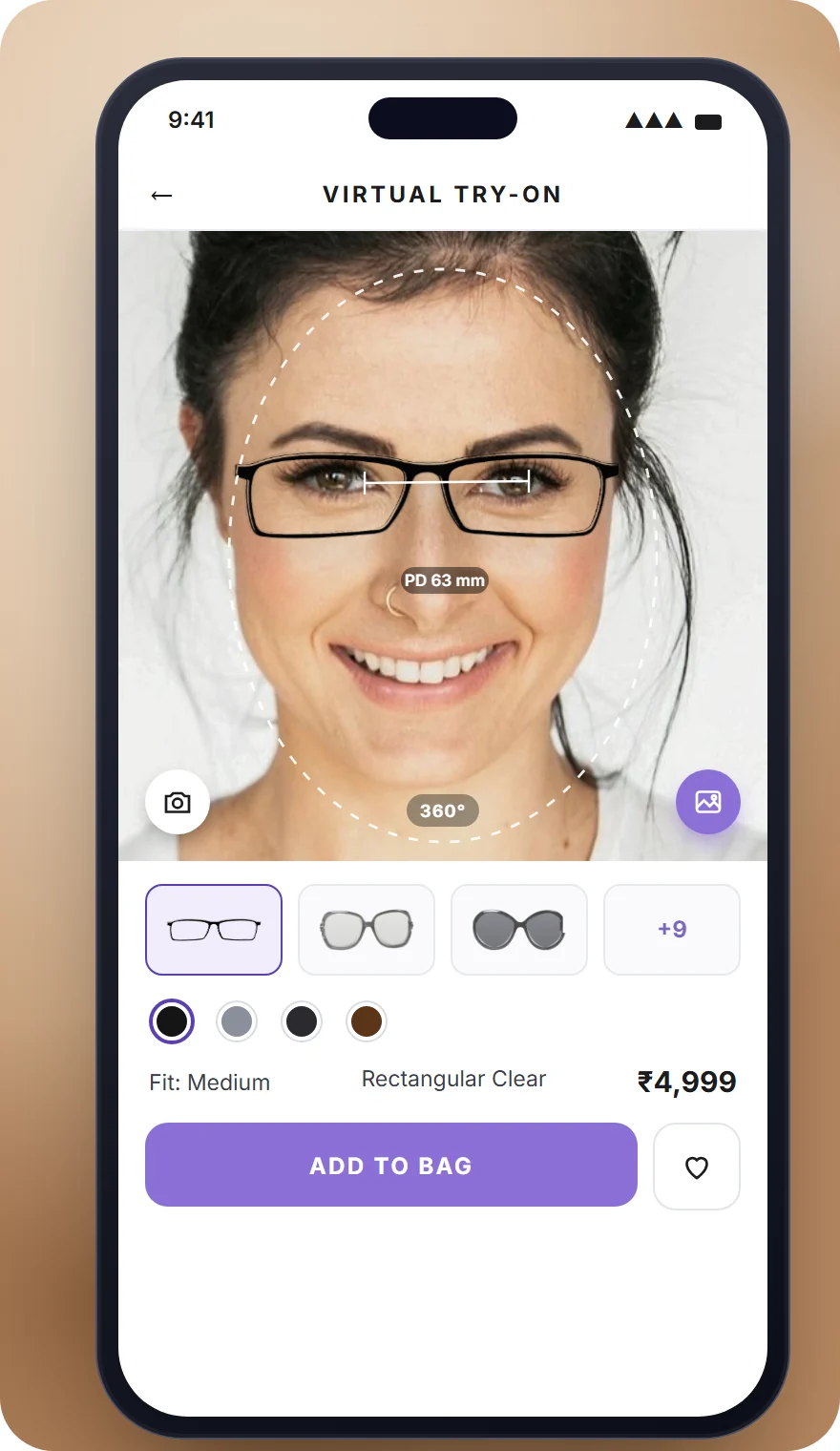
A virtual glasses try-on tracks the shopper's face through the phone or laptop camera, finds the eyes, nose bridge and temples from 468 face-mesh landmarks, scales a 3D model of each frame to the shopper's measured pupillary distance and face width, and renders it every frame with lens reflections and the scene's lighting, so a spectacle or sunglass looks the way it would in a mirror. SpikeSecure builds this for your website (no app needed) and apps: a web widget costs ₹4–10 lakh and takes 8–10 weeks; adding it to an Android and iOS app costs ₹8–18 lakh. 3D frame models are created by photogrammetry or modelling and quoted per SKU.
Eyewear is the most mature try-on category because faces are easy to track and frames are rigid objects, which is why the big Indian eyewear retailers lead with it. The same technology is now affordable for independent opticians, D2C eyewear brands and marketplaces, and it connects to the store you already run.
Stills from the try-on screen with real frame photos on the same face. In the product the frames sit on the shopper's live camera feed, sized to their measured pupillary distance.
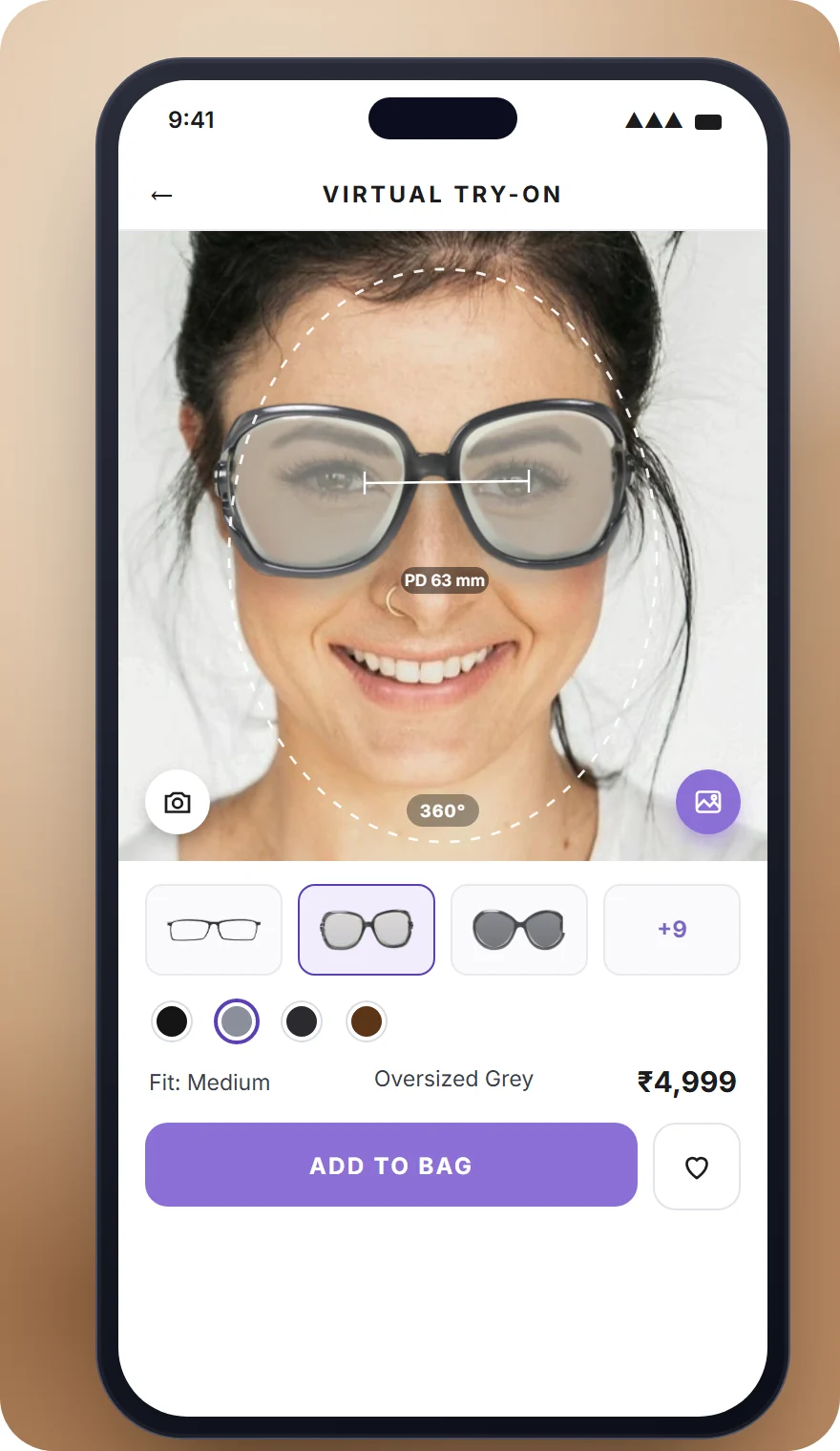
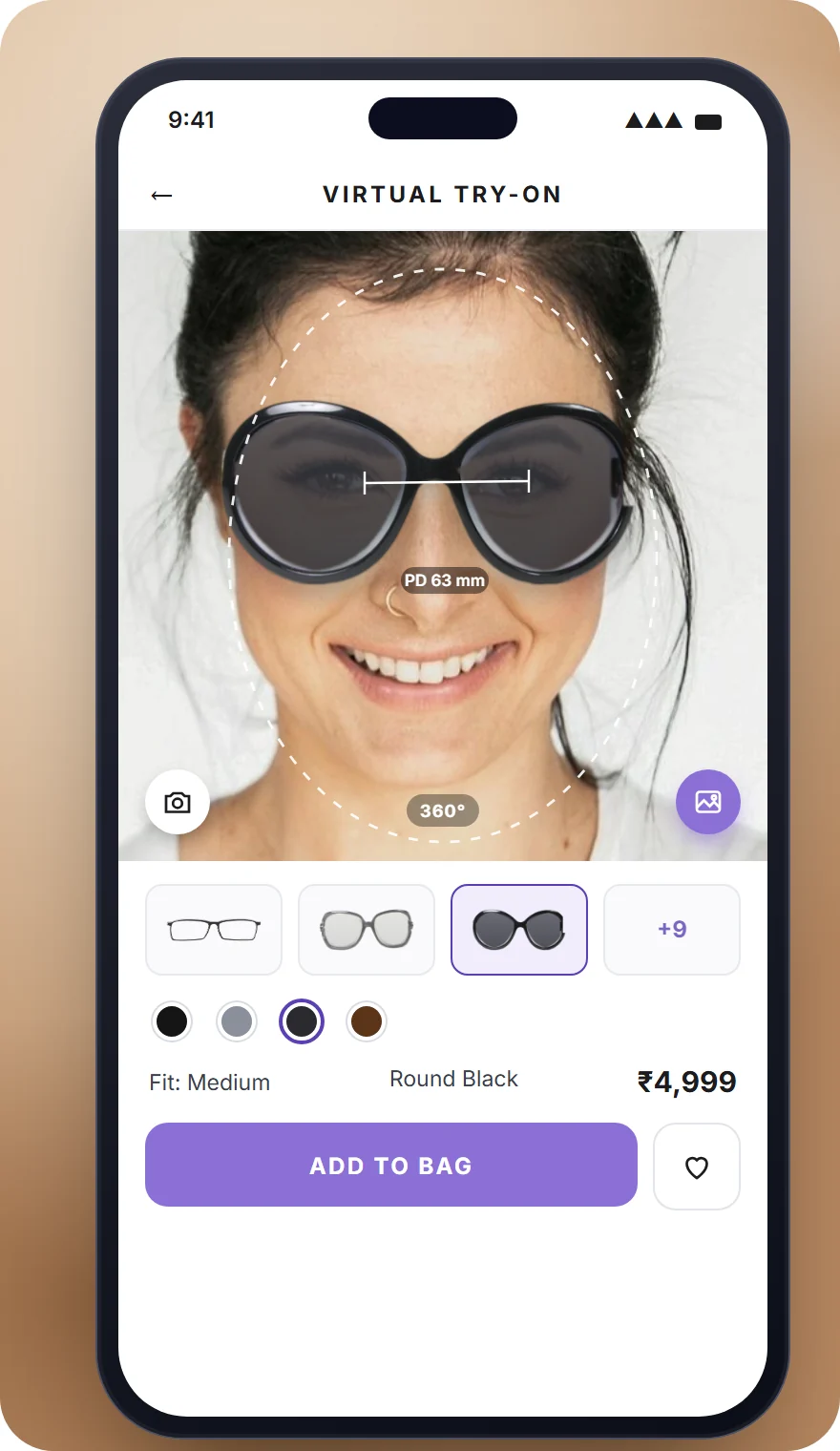
Frame photos: rawpixel.com (CC0); queenbeeofbeverlyhills on Flickr (CC BY 2.0). Model photo: Unsplash.
468-point face mesh with head-pose estimation, so frames stay attached when the shopper turns, and pupillary-distance measurement from a card or phone reference for true-to-scale sizing.
Photogrammetry rigs or manual modelling into GLB and USDZ, with physically based materials for acetate, TR90, metal and wood, and colour variants from one base model. Quoted per SKU, with a QA sheet.
Clear, tinted, gradient, mirrored and photochromic lenses with reflections and slight refraction, plus power-lens thickness preview for high prescriptions where required.
Hair, hands and existing glasses handled so temples pass behind ears and hair correctly; lighting estimated from the camera so metal frames reflect the room.
Try-on button on product and listing pages, catalogue and stock sync, add-to-cart and wishlist from the try-on, saved looks and share cards, on Shopify, WooCommerce, Magento or a custom store.
Face-shape detection with suggested frame styles, most-tried frames, add-to-cart and conversion from try-on, and return-rate comparison in a dashboard.
Browser-based try-on on your existing store, first batch of frames digitised, catalogue sync, analytics. 8–10 weeks.
Flutter app for Android and iOS with native ARKit and ARCore try-on, catalogue, cart, saved looks, or try-on added to your existing app. 10–14 weeks.
Photogrammetry or manual modelling, materials, colour variants and QA. Quoted per SKU or per batch of 50 or 100; brands with GLB files from manufacturers skip most of this.
PD measurement, face-shape finder, prescription capture and lens-power preview, virtual mirror kiosks for stores, Instagram and Snapchat lenses for campaigns.
Number of frames, whether 3D assets exist, web versus app versus both, and in-house tracking versus a licensed SDK.
CDN hosting for 3D assets, new SKU digitisation, optional SDK licences, maintenance from ₹20,000 per month.
The same six steps run on every project we take in Coimbatore, whether it is a five-page website or a multi-vendor platform.
Catalogue audit (how many SKUs, what imagery or 3D exists), platform choice (web widget, app or both), accuracy targets, and a fixed-scope written quote within 48 hours.
3D modelling or photogrammetry of frames, shade calibration from product swatches, with a QA sheet per SKU.
Face and hand landmark tracking, lighting and occlusion handling, rendering on WebGL or native AR, tested on mid-range Android phones and iPhones.
Shopify, WooCommerce, Magento or custom storefront integration, product mapping, add-to-cart from the try-on, analytics events.
Accuracy checks across skin tones, lighting and face shapes, performance budgets, privacy review (camera consent, on-device processing), accessibility.
Conversion and engagement dashboards, A/B tests on placement, new SKUs added through the pipeline, 30-day warranty then optional maintenance.
A browser-based eyewear try-on on an existing store costs ₹4–10 lakh at SpikeSecure and takes 8–10 weeks; an Android and iOS app with try-on costs ₹8–18 lakh. 3D frame models are quoted per SKU, and brands that already have GLB files from manufacturers pay much less for digitisation.
Yes. The same face-tracked 3D try-on with true-to-scale frames, lens previews and add-to-cart, built for your own website, app or in-store mirror kiosk and connected to your catalogue. We build the experience for you rather than reselling another retailer's technology.
Yes. The web try-on runs in Chrome and Safari on Android and iPhone using WebGL and on-device face tracking, so shoppers try frames directly from a product page. An app adds better performance and native AR features.
We measure the shopper's pupillary distance once, using a reference card or the phone's depth sensor, and scale every frame model to real millimetres. Frames then appear at their true size, so a shopper can compare a 50 mm and a 54 mm lens honestly.
Yes, each frame needs a 3D model, but colour variants come from one base model and we create models by photogrammetry or manual modelling if your manufacturer cannot supply them. We start with your best-selling frames and add the rest through the pipeline.
Yes. Clear, tinted, gradient, mirrored and photochromic lenses are rendered with reflections, and high-power lens thickness can be previewed where you sell prescription glasses.
Yes. Face-shape detection from the landmarks suggests suitable styles, and analytics show which frames are tried and bought most, which also informs buying.
Yes. D2C sunglasses brands, multi-brand eyewear marketplaces and optical chains use the same module, with vendor-level catalogues and analytics for marketplaces.
A 30-minute discovery call and a fixed-scope quote — usually within 48 hours. No deck, no sales theatre.