Cab booking app developers
Taxi & cab booking app development · India

Taxi App Development Company in India

SpikeSecure Technologies builds taxi, cab and bike taxi booking platforms from CHIL SEZ IT Park, Coimbatore, for travels operators and ride-hailing startups across India: a rider app, a captain app and a dispatch console, with bike, auto and cab classes, upfront fares and surge by zone, ride OTP and SOS, driver KYC and automated payouts. Fixed-scope written quote within 48 hours; apps from ₹4 lakh.

  • ₹4L+fleet booking app, published
  • 3 appsrider · captain · admin
  • 10–16 wkstwo-sided platform
  • 48 hrsto a written quote
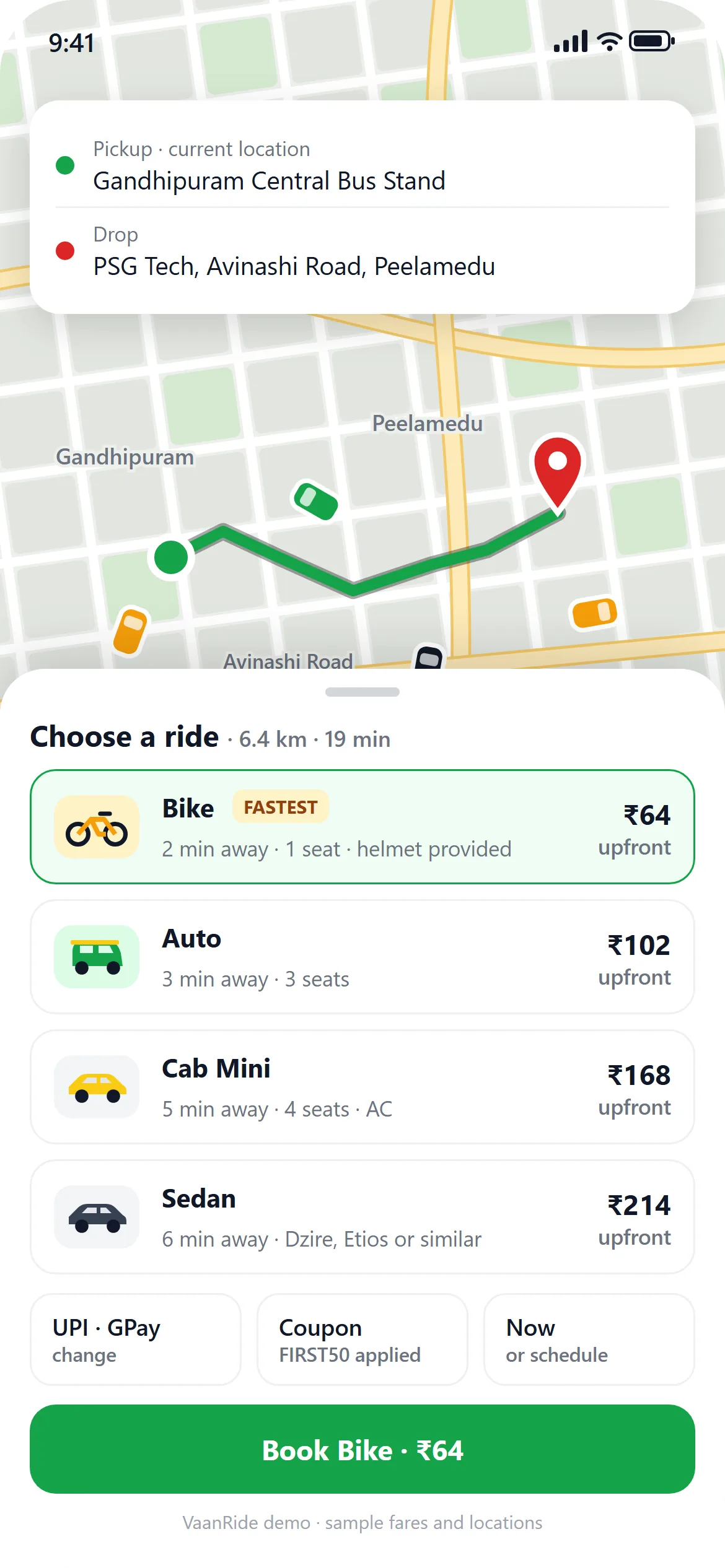
Taxi app booking screen (illustrative, sample data): Coimbatore route with bike, auto, cab and sedan fares and UPI payment
Direct answer

What a taxi app development company in India builds for you.

SpikeSecure Technologies Pvt. Ltd. is a taxi and cab booking app development company in India, based at CHIL SEZ IT Park, Saravanampatti, Coimbatore, Tamil Nadu. We build three connected products: a rider app for booking bike, auto and cab rides, a captain app for drivers, and a web console where your team dispatches trips, sets fares and surge, approves driver documents, handles SOS alerts and pays drivers. Apps are built in Flutter for Android and iOS, on a Node.js and PostgreSQL backend with geospatial matching in Redis.

Choose us if you want a fixed price for a written scope, a test build on your phone every sprint, a field pilot with your own drivers before launch, and code and store accounts in your name. We publish our price ranges and do not claim to be the top or best taxi app company; the screens and evidence below are what we can show.

  • Typical budget: ₹7–18 lakh for a ride-hailing platform: rider app, captain app and admin with matching, fare and surge rules, SOS, driver KYC and payouts, built in 10–16 weeks.
  • Indicative cost in India: Fleet booking app ₹4–8 lakh; two-sided ride-hailing platform ₹7–18 lakh; multi-city platform ₹18–30 lakh and up. Confirmed in a fixed-scope written quote.
  • Typical timeline: 6–8 weeks for a fleet booking app, 10–16 weeks for a rider, captain and admin platform, longer for several cities.
  • Vehicle classes: Bike taxi, auto rickshaw, e-rickshaw, cab mini, sedan, SUV, rentals by the hour and outstation trips, each with its own fare card.
  • India-specific builds: UPI and cash fares, ride OTP and SOS, Aadhaar eKYC with consent, licence and RC checks, RazorpayX payouts with TDS, GST invoices, Tamil, Hindi and other language interfaces, and state-by-state rules configured per city.
  • Where we work: One office, in Coimbatore. Coimbatore and Tamil Nadu in person; Chennai with on-site visits; the rest of India remotely with weekly demos.
  • Related: bike taxi app development, taxi app developers in Chennai, cab booking app developers in Coimbatore, mobile app development company in India, food delivery app developers, QuickBite case study
App screens

What a taxi app we build looks like.

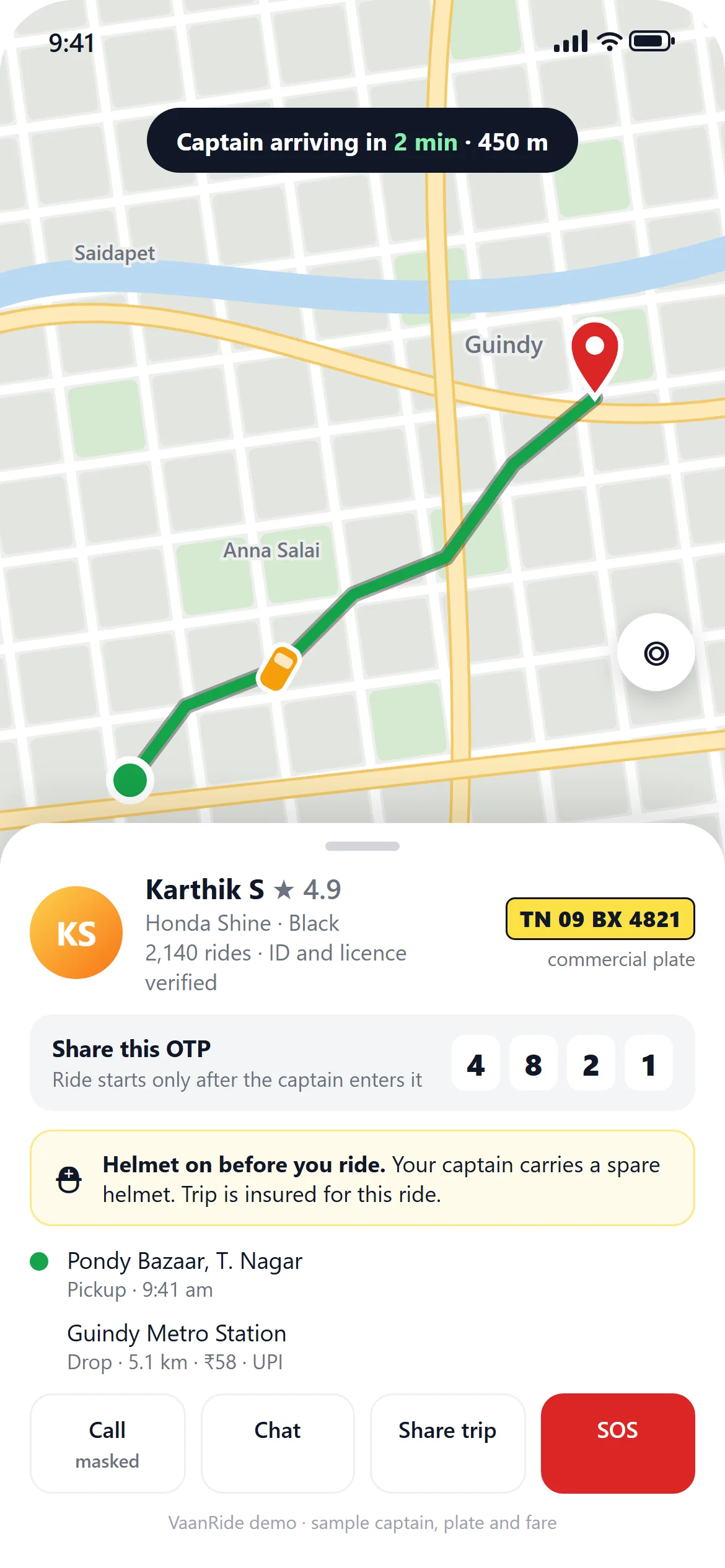
Rider, captain and operations screens for a bike, auto and cab platform: booking, a live bike ride, a captain's ride offer, the receipt, driver onboarding and the dispatch console.

Bike taxi app tracking screen (illustrative, sample data): captain arriving for a Chennai ride, with ride OTP and SOS
Rider app: bike ride on the wayCaptain, vehicle and commercial plate, a ride OTP so the trip starts only with the right rider, a helmet reminder, masked calls, trip sharing and one-tap SOS.
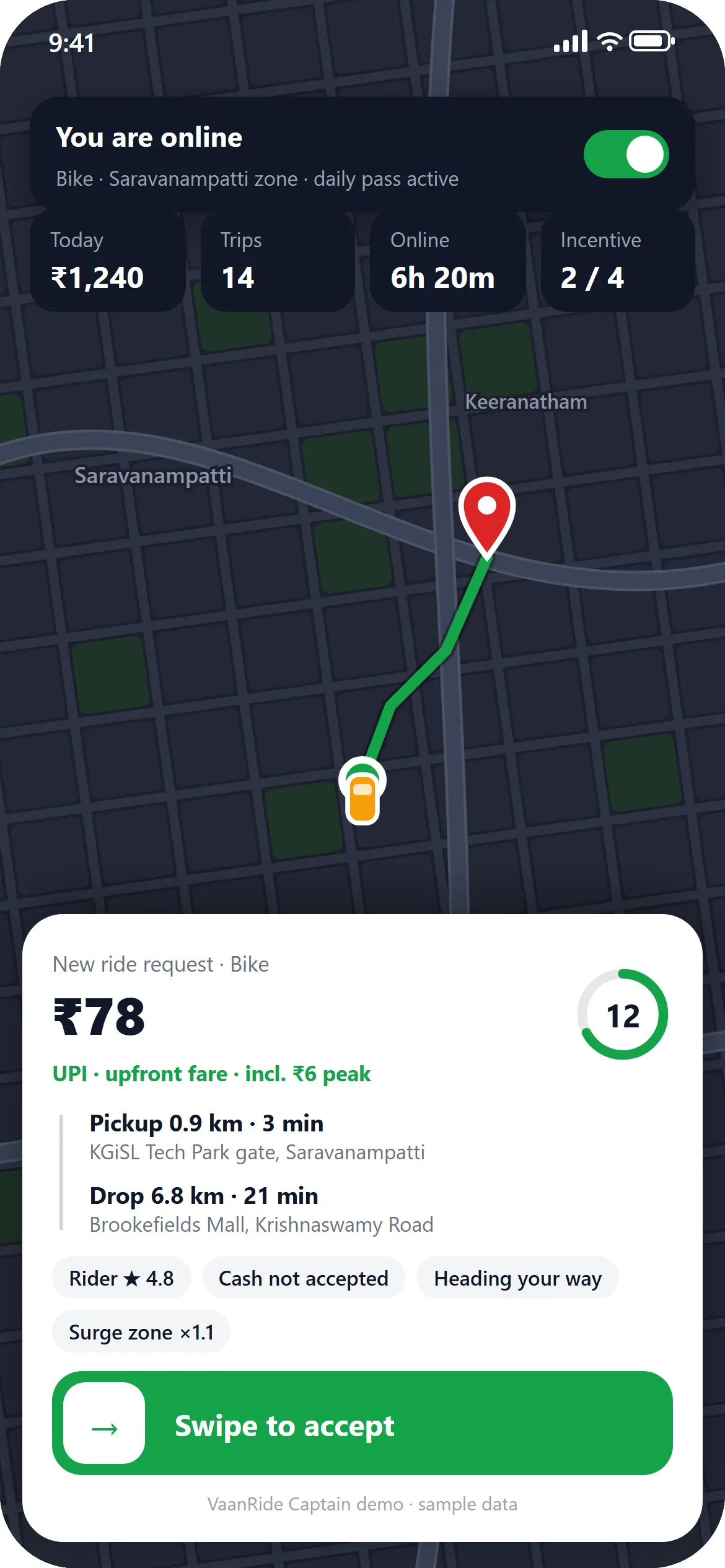
Taxi driver app ride request (illustrative, sample data): online toggle, earnings, bike ride offer and swipe to accept
Captain app: ride requestOnline toggle, earnings, trips and incentive progress, then an offer with the fare, pickup and drop distances, payment mode and a timed accept.
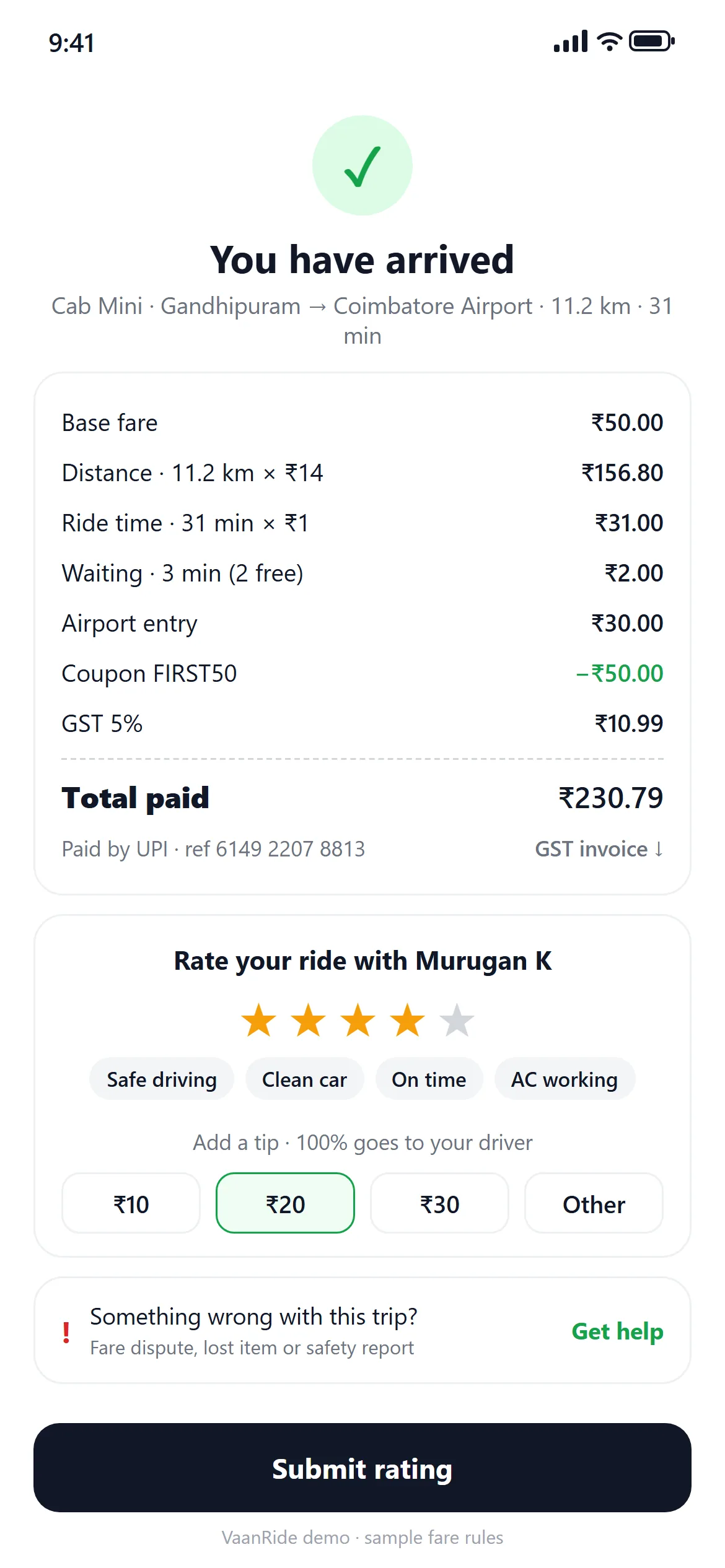
Taxi app trip receipt (illustrative, sample data): fare breakdown with GST, UPI payment, driver rating and tip options
Receipt, rating and tipLine-by-line fare with base, distance, time, waiting, tolls or airport entry, coupon and GST, a GST invoice, UPI reference, rating tags, tips and a help link for disputes.
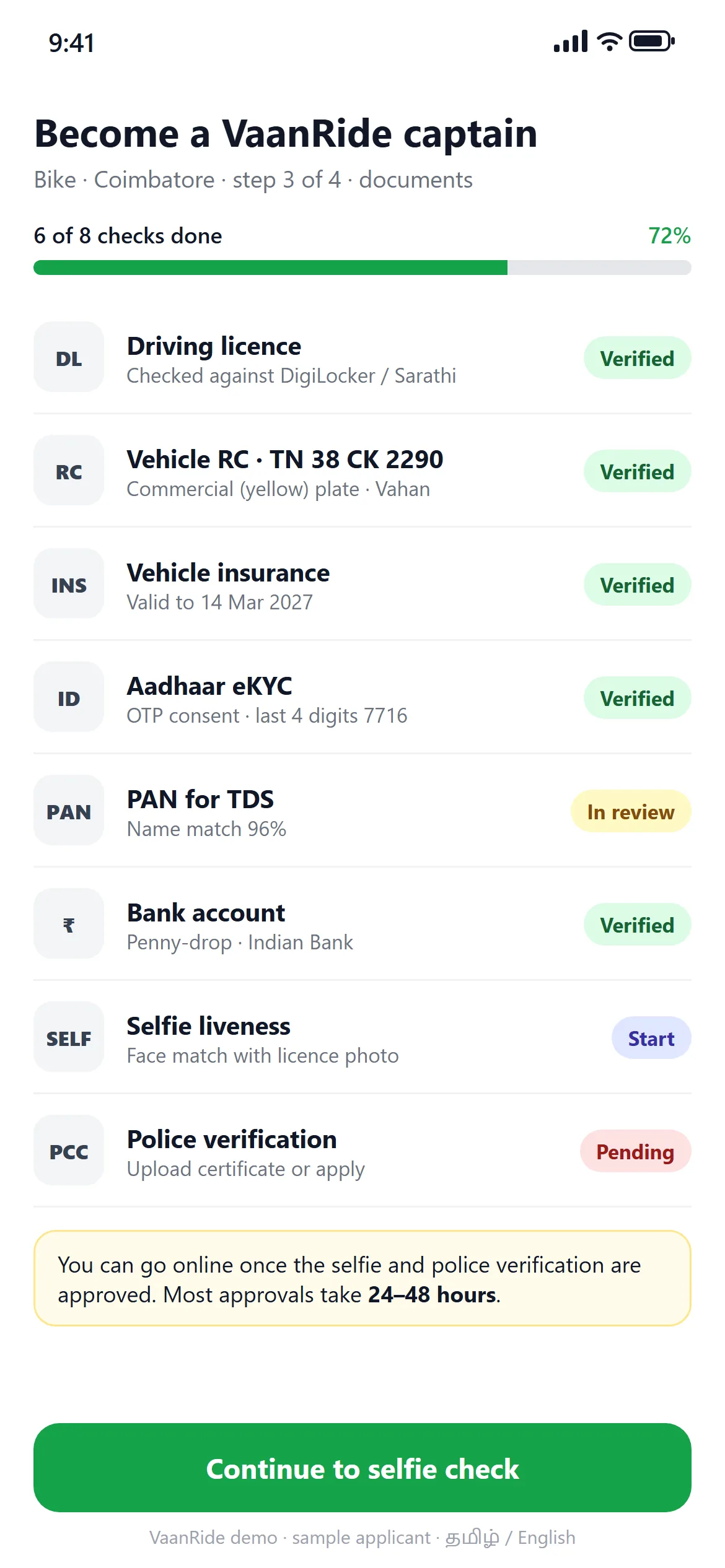
Taxi driver onboarding screen (illustrative, sample data): licence, RC, insurance, Aadhaar, PAN, bank and selfie checks
Driver onboarding and KYCLicence, RC, insurance, Aadhaar eKYC, PAN for TDS, bank penny-drop, selfie liveness and police verification, each with a status the ops team can act on.
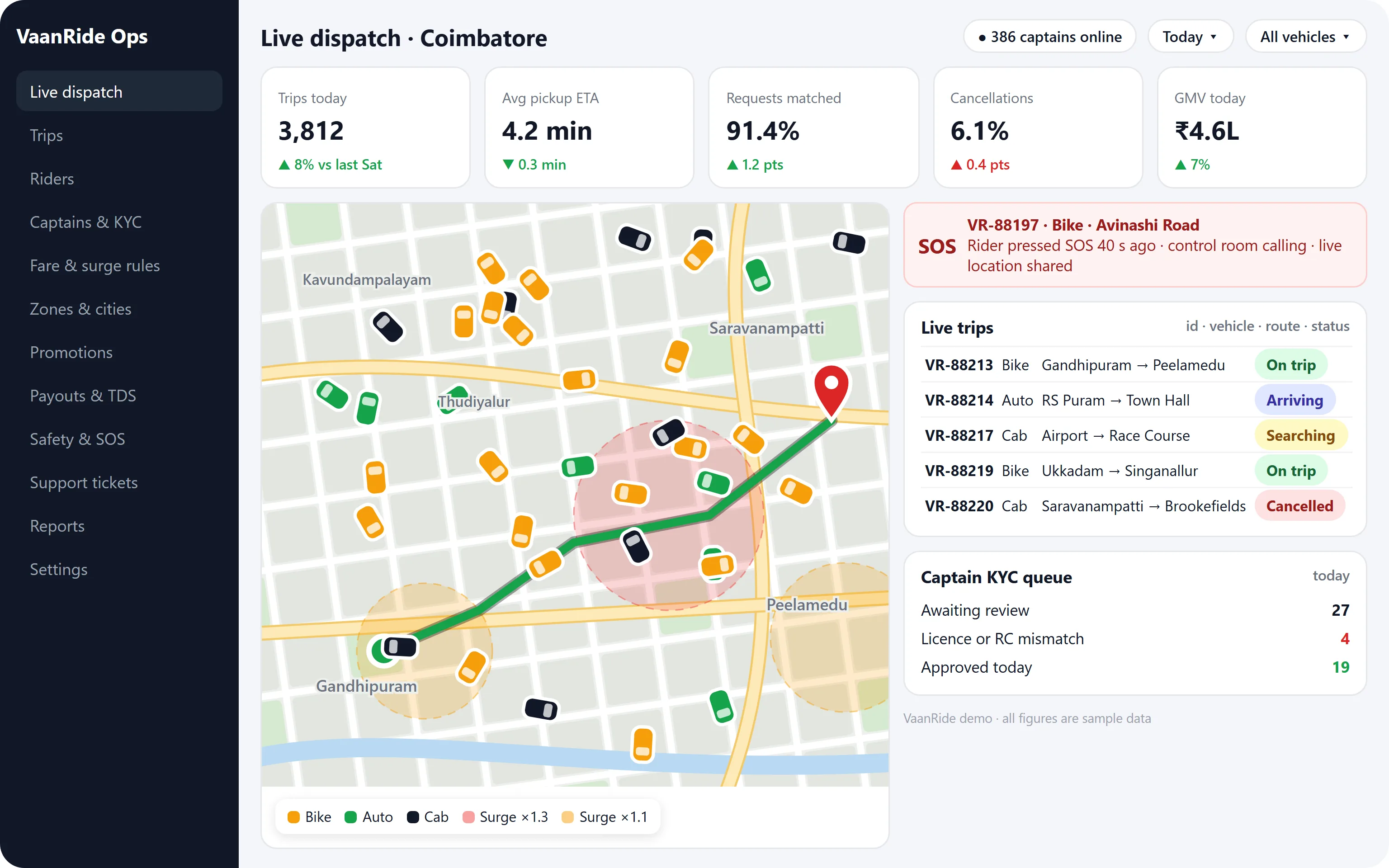
Taxi dispatch dashboard (illustrative, sample data): live Coimbatore map with bikes, autos, cabs, surge zones and SOS alert
Dispatch and operations console (web)Live map of bikes, autos and cabs with surge zones, the day's trips, pickup ETA, match rate and cancellations, SOS alerts on top, live trips and the KYC queue.

Illustrative screens rendered by SpikeSecure for this page. The app name VaanRide, people, number plates, fares and every figure are sample data, not a client's app or any real app's interface; your build carries your brand, fare rules and cities.

What is included

Six systems behind every ride.

Riders judge the app on how fast a driver accepts and whether the fare is what they were shown. Drivers stay for prompt payouts. These are the parts that decide both.

01

Rider app

Pickup and drop with saved places and landmarks, bike, auto, cab and sedan classes with upfront fares, scheduled and rental rides, live tracking, ride OTP, masked calls and chat, trip sharing, SOS, ratings, UPI, cards, wallet and cash, and Tamil, Hindi or other Indian-language interfaces.

02

Captain (driver) app

Online and offline toggle, timed ride offers, navigation hand-off to Google Maps, waiting and toll capture, earnings, incentives and daily or weekly payouts, battery-aware background location, and a document wallet for licence, RC and insurance renewals.

03

Matching and dispatch

Captains indexed geospatially and scored on distance, heading, acceptance history and rating; radius expansion and re-offer when a captain declines; manual dispatch from the console for phone bookings and corporate trips.

04

Fare and surge engine

Base fare, per-km and per-minute rates per vehicle class and city, minimum fare, waiting, night charges, tolls and airport entry, cancellation fees, surge by zone and time with caps, coupons and referral credits, all editable without an app release.

05

Safety

Ride OTP, one-tap SOS to emergency contacts and your control room, live trip sharing, number masking, women-safety options such as share-by-default, verified badges, trip replay for disputes, and helmet and insurance prompts for bike rides.

06

Driver KYC and payouts

Licence, RC, insurance, Aadhaar eKYC with consent, PAN, bank penny-drop, selfie liveness and police verification, with an ops queue; payouts through RazorpayX or Cashfree with TDS where it applies, and commission or subscription billing for drivers.
Taxi app development cost in India

What a taxi app costs to build in India.

What you are launchingApps includedIndicative costTypical timeline
Fleet or travels booking appRider app, web admin with manual or auto dispatch₹4–8 lakh6–8 weeks
Bike taxi or auto MVP, one cityRider app, captain app, admin, payouts₹7–12 lakh10–12 weeks
Bike, auto and cab platformRider, captain, admin, fare and surge engine, KYC, SOS₹12–18 lakh12–16 weeks
Multi-city platformAll of the above plus zones, rentals, outstation, corporate accounts₹18–30 lakh and up16 weeks and up

Short answer: a taxi or bike taxi app in India costs ₹4–8 lakh for an operator's own fleet, ₹7–18 lakh for a two-sided ride-hailing platform and ₹18–30 lakh and up for several cities. Maps and SMS charges, gateway fees, developer accounts and GST are extra. The figure is fixed in a written quote after discovery.

Pricing detail

Published ranges, and what moves them.

The same ranges as our Coimbatore cab booking page, so the price does not change with your city. Indicative, confirmed in a fixed-scope written quote after discovery.

01

Fleet booking app — ₹4–8 lakh

Rider app plus web admin for an operator running its own cabs or autos: booking, upfront fare, dispatch from the console, live tracking, UPI and cash. 6–8 weeks.

02

Ride-hailing platform — ₹7–18 lakh

Rider and captain apps plus full admin: matching engine, fare and surge rules, bike, auto and cab classes, SOS, driver KYC and automated payouts. 10–16 weeks; a single-city bike or auto MVP usually sits in the lower half of the range.

03

Multi-city platform — ₹18–30 lakh and up

Several cities and zones, rentals and outstation, pooling, corporate accounts, subscriptions for drivers, fraud detection and infrastructure for scale. Priced after technical discovery.

04

What drives the number

Whether you need an open captain app or dispatch your own fleet, how many vehicle classes and cities you launch with, the sophistication of matching and surge, and the payout and compliance work.

05

Running costs to plan for

Maps, routing and places API calls (the largest recurring cost; they grow with trips), cloud hosting, SMS OTP and number masking, KYC verification calls and gateway fees, all billed by those providers. We model them against your projected trips before the build.

06

Maintenance — from ₹15,000 per month

OS and SDK updates, store-policy changes, security patches, monitoring and small features. Optional; every build ships with a 30-day post-launch warranty.

Business models

Which taxi app model fits your business.

01

Travels and fleet operators

You own or lease the cars and employ or attach the drivers. A rider app and a dispatch console replace phone bookings; a driver app is optional. The quickest and cheapest launch.

02

Open ride-hailing marketplace

Independent captains sign up, pass KYC and take rides; you earn a commission per ride. Needs the full matching, surge, payout and safety stack.

03

Subscription or daily pass for drivers

Drivers pay a fixed daily, weekly or monthly fee instead of a per-ride commission, a model several Indian platforms now use for autos and bikes. We build the plans, auto-debit and the rules that switch a driver offline when a pass lapses.

04

Corporate and airport transport

Employee pick-up and drop with rosters, airport transfers with fixed fares, invoicing to companies and monthly GST statements.

05

Outstation and rentals

One-way and round trips between cities, hourly rentals, driver allowances, tolls and state permits captured on the bill.

06

Open network (ONDC) mobility

If you want rides discoverable through buyer apps on the Open Network for Digital Commerce, we scope that integration in discovery; it depends on network participant approval, so we treat it as a separate phase.

Built for Indian roads

What breaks taxi apps in India, and how we handle it.

01

GPS drift in dense streets

Server-side map-matching snaps traces to roads, so fares by distance stay accurate in narrow lanes and under flyovers.

02

Patchy networks

Trip state is stored on the phone and synced when the signal returns, so a dead zone does not end a trip or lose a fare.

03

Budget Android phones

Battery-aware location sampling so a captain's phone lasts a shift, small app size, and testing on mid-range Android phones, not only flagships.

04

Cash and UPI on the same trip

UPI intent, cards and wallets with cash as a fallback, driver cash ledgers and settlement of commission owed against cash rides.

05

Landmark addresses

Search that understands landmarks and local names, saved places, pin drop and pickup points at malls, stations and airports.

06

Rules that differ by state

Vehicle classes, permits, fare caps and document lists configured per city, because aggregator rules and bike taxi permission are set by each state.

Delivery process

How a taxi app build runs, from discovery to launch.

The same six steps run on every project we take in Coimbatore, whether it is a five-page website or a multi-vendor platform.

01

Discovery — week 1

Your model (own fleet, open marketplace, or both), vehicle classes, launch city and zones, fare rules, payout model and the state rules you operate under; a fixed-scope written quote within 48 hours.

02

Prototype — weeks 1–3

Clickable rider, captain and admin flows on your phone, tested with a few real drivers before any code.

03

Build in sprints

Two-week sprints with TestFlight and Play internal builds, a weekly demo, GitHub access from day one, and time-to-match measured from the first working build.

04

Field test in your city

Closed pilot with your first captains on real roads: GPS drift, battery, network dead zones, OTP and payout runs, with fixes before the public launch.

05

Store submission

Listings, screenshots, background-location and data-safety declarations, and submission under your own Apple and Google accounts.

06

Launch and warranty

Monitored launch, a 30-day warranty, optional maintenance from ₹15,000 a month; code, store accounts, maps keys and cloud accounts stay in your name.

Evidence

Real-time work you can check.

  • QuickBite (food delivery platform). The same real-time core a taxi app needs: a customer app, a restaurant console and a rider app with automated dispatch, live order tracking and cash-on-delivery reconciliation. Outcome, as reported by the client: from a Figma file to live on the App Store and Play Store in 11 weeks, on budget.
  • Local Friends (SpikeSecure's own product). A Flutter app in production with a per-minute wallet, identity checks, moderation and payouts to hosts, the same money and trust plumbing that a captain app needs.

We have not yet published a taxi or bike taxi client by name. We name clients only with written permission and quote outcomes in their words; the screens on this page are sample data. Ask for a walkthrough of the dispatch and payout code on the discovery call.

Where we build

Taxi apps for Coimbatore, Chennai and every Indian city.

Coimbatore and western Tamil Nadu

Travels operators and startups in Coimbatore, Tiruppur, Erode, Salem and Pollachi meet us at Rajalakshmi Sai Complex, near Sankara College, CHIL SEZ IT Park, Saravanampatti, Coimbatore 641035, Monday to Saturday, 9:30 am to 6:30 pm IST (map). Local detail: cab booking app developers in Coimbatore.

Chennai

Delivered from Coimbatore with on-site kick-off and launch visits; we have no Chennai office. Airport, metro-feeder and OMR commute builds are covered on taxi app developers in Chennai.

Bengaluru, Hyderabad, Mumbai, Pune, Delhi NCR, Kochi and the rest of India

Delivered remotely with the same written scope, sprint builds and field pilot. Fares, vehicle classes and document lists are configured per city, so a second city is a settings change plus a local pilot, not a rebuild.

Bike taxis

Captain onboarding, helmet and insurance flows and state rules for two-wheeler rides are on bike taxi app development.

Our stack

What we build ride-hailing platforms on.

  • Flutter
  • Kotlin
  • Swift
  • Node.js
  • NestJS
  • PostgreSQL
  • PostGIS
  • Redis GEO
  • WebSockets
  • Firebase Cloud Messaging
  • Google Maps Platform
  • Mapbox
  • OSRM
  • Razorpay
  • RazorpayX
  • Cashfree
  • Exotel
  • AWS
FAQ

Questions before your taxi app build.

How much does it cost to develop a taxi app in India?

At SpikeSecure a fleet booking app costs ₹4–8 lakh, a two-sided ride-hailing platform with rider and captain apps ₹7–18 lakh, and a multi-city platform ₹18–30 lakh and up. Maps and SMS charges, KYC verification calls, gateway fees, developer accounts and GST are extra. The final price is fixed in a written quote after discovery.

How long does taxi app development take?

6–8 weeks for a fleet booking app and 10–16 weeks for a rider, captain and admin platform, including a field pilot with your first drivers. Several cities take longer.

Is SpikeSecure a taxi app development company in India?

Yes. SpikeSecure Technologies Pvt. Ltd. is based at CHIL SEZ IT Park, Saravanampatti, Coimbatore, Tamil Nadu, and builds taxi, cab, auto and bike taxi apps for clients across India. We have one office, in Coimbatore.

Can one app handle bike, auto and cab rides?

Yes. Vehicle classes share one rider app, one captain app and one console; each class has its own fare card, document list and matching radius, and you can switch a class on or off per city.

Which payments and payouts do you support?

UPI, cards, wallets and cash for riders through Razorpay or Cashfree; daily or weekly driver payouts through RazorpayX or Cashfree Payouts with TDS where it applies; commission or subscription billing for drivers; GST invoices for riders and companies.

Can you build an app like Ola, Uber or Rapido?

We build ride-hailing platforms with the same kind of functions (rider and captain apps, matching, fare and surge rules, live tracking, SOS, KYC and payouts) under your own brand, design and fare rules. We do not copy any company's code, design or content. Ola, Uber and Rapido are trademarks of their respective owners and are named here only to describe the type of app.

Do we own the source code and the apps?

Yes. The code is in your GitHub organisation from day one, and the apps are published under your own Apple and Google developer accounts, with maps, SMS, payment and cloud accounts in your name.

How do you keep maps costs under control?

We cache places and geocoding results, request routes only when a trip needs them, use map-matching on the server rather than per-second API calls, and can use open-source routing (OSRM) for estimates. We model the monthly maps bill against your projected trips before the build.

Let's build

Ready to launch yourtaxi app*?

A 30-minute discovery call and a fixed-scope quote — usually within 48 hours. No deck, no sales theatre.

Or email our team at info@spikesecure.com · give us a call at +91 95149 94888 · WhatsApp