Software development
Restaurant POS software development · India

Restaurant POS software development company in India with offline billing, KDS and Swiggy-Zomato sync built in.

SpikeSecure Technologies builds restaurant POS and restaurant operating systems from Coimbatore for cafés, QSR chains, cloud kitchens, bars and multi-outlet brands across India. Offline-first billing, kitchen display, inventory and recipe costing, QR and online ordering, aggregator sync, GST e-invoicing and multi-branch dashboards, on a fixed-scope written quote. Golak, a restaurant operating system used by 180+ operators, is a SpikeSecure client.

  • 46modules in Golak, our client's restaurant OS
  • ₹3L+indicative starting price
  • 8–24 wkstypical build
  • 48 hrsto a written quote
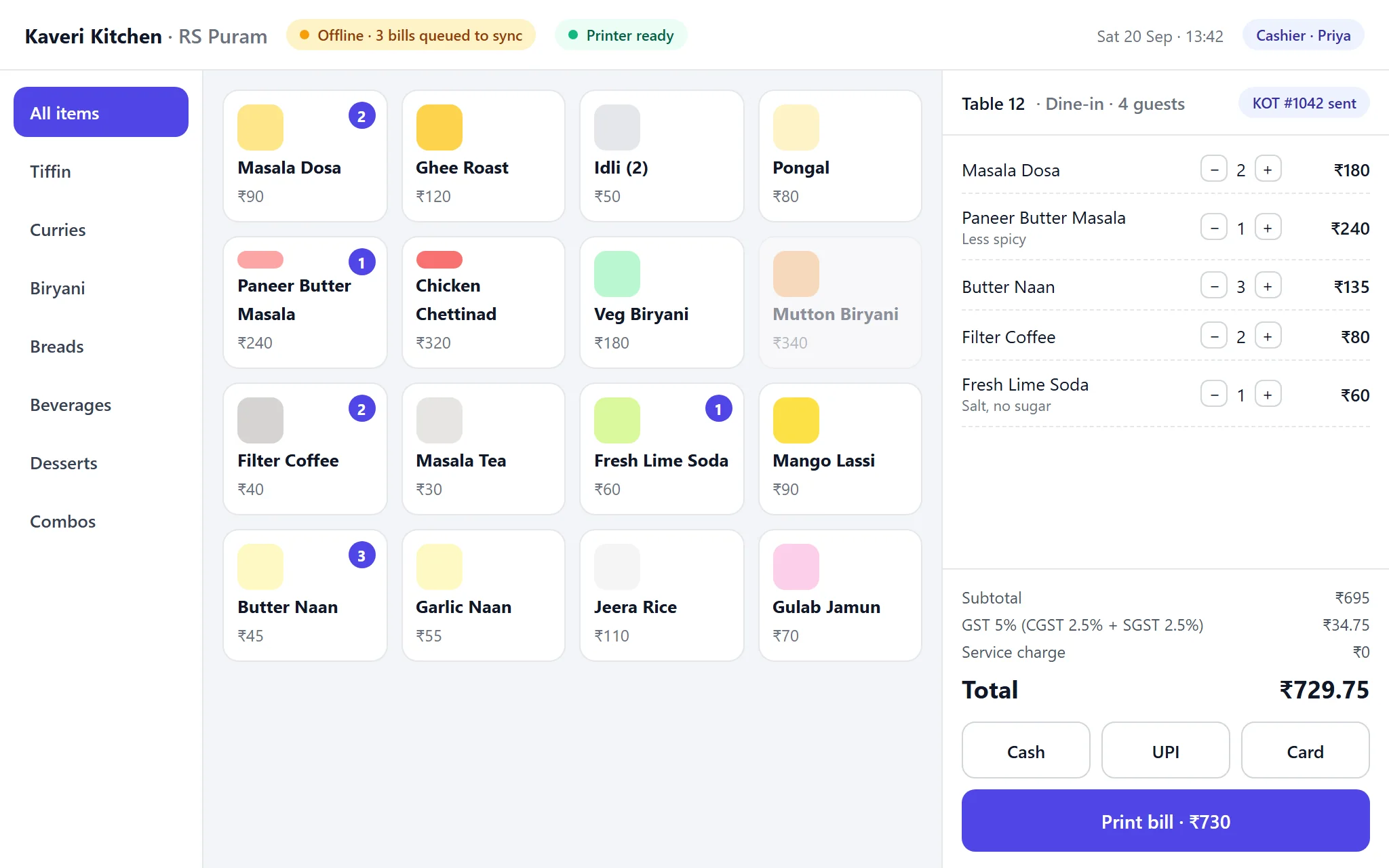
Illustrative product UI · sample dataRestaurant POS billing screen on a tablet: menu tiles for tiffin items, a Table 12 dine-in cart with KOT sent, GST split and UPI, card and cash buttons, with an offline badge showing three bills queued to sync
Direct answer

Which restaurant POS software development company in India should you choose?

SpikeSecure Technologies Pvt. Ltd. is a restaurant POS software development company based at CHIL SEZ IT Park, Saravanampatti, Coimbatore, Tamil Nadu, building custom restaurant POS and restaurant operating systems for cafés, quick-service chains, cloud kitchens, bars, food courts and multi-outlet brands across India. A typical build covers offline-first billing that keeps printing bills without internet and syncs when the connection returns, a kitchen display system, inventory and recipe costing, QR table ordering and an own-domain online store, two-way Swiggy, Zomato and ONDC sync, GST-compliant e-invoicing, CRM and loyalty, staff attendance and payroll, and multi-branch dashboards. Choose us if you need a system built around how your outlets actually run, or a white-label restaurant SaaS you can sell, rather than a generic billing app.

Golak, a restaurant operating system headquartered in Saravanampatti, Coimbatore, is a SpikeSecure client: 46 modules, offline-capable billing, KDS, inventory, QR ordering, aggregator sync, AI forecasting and payroll on one platform, with plans from ₹749 per outlet per month and 180+ operators across 14 cities in Tamil Nadu, Kerala and Karnataka, as published on golak.store. We deliver from Coimbatore with in-person discovery in Coimbatore, Chennai and Tiruppur, and remotely for Bengaluru, Hyderabad, Mumbai, Pune, Delhi NCR, Kolkata, Ahmedabad, Kochi and every other Indian city, on a fixed-scope written quote with weekly staging demos and a 30-day warranty.

  • Indicative cost in India: POS customisation on an existing platform from ₹3 lakh; custom single-brand POS with billing, KDS and inventory ₹6–12 lakh; multi-branch restaurant operating system with aggregator sync, online ordering, CRM and payroll ₹12–30 lakh; white-label restaurant SaaS from ₹20 lakh. Confirmed in a written fixed-scope quote.
  • Typical timeline: POS customisation 4–8 weeks; custom POS with KDS and inventory 8–14 weeks; multi-branch restaurant OS 16–24 weeks; pilot outlet live first, then rollout outlet by outlet.
  • What is included: discovery and written scope, UX for billing counters and kitchens, POS terminal apps, KDS, back office, integrations, hardware setup (thermal printers, cash drawers, scanners, scales), GST e-invoicing, data migration from your current billing software, staff training, launch support and a 30-day warranty.
  • Where we work: Coimbatore, Chennai and Tiruppur in person; Bengaluru, Hyderabad, Mumbai, Pune, Delhi NCR, Kolkata, Ahmedabad, Kochi, Madurai and the rest of India remotely with on-site kick-off on request; GCC and international clients remotely.
  • Ownership: you own the source code, cloud accounts, app store listings and data from day one; no per-terminal licences on custom builds.
  • Related: software development company in Coimbatore, ERP software developers, CRM software developers, food delivery app developers, mobile app developers, Golak restaurant operating system (client), case studies
High-level architecture

How a restaurant POS we build is put together.

Six layers, each independently deployable, so a single café can start with billing and KDS and a 50-outlet chain can run the whole stack.

01

1. POS terminal apps (offline-first)

Billing apps for Android tablets, iPads, Windows and macOS desktops and the browser, with a local database so bills, KOTs and payments keep working without internet and sync automatically when it returns. Table, counter, takeaway and delivery order types, split bills, discounts, service charge and tips, and 58 mm and 80 mm thermal printing.

02

2. Kitchen display and printing

KDS screens per station (grill, fryer, bar, dessert) with ticket timers, bump and recall, course firing and expo view, plus kitchen printers as a fallback. Orders from every channel land in the same queue so the kitchen never runs two systems.

03

3. Order channels

Dine-in, QR table ordering, self-ordering kiosks, an own-domain online ordering store with UPI and cards, WhatsApp ordering, and two-way sync with Swiggy, Zomato and ONDC so menus, stock-outs and order status stay consistent everywhere.

04

4. Inventory and recipe costing

Ingredient-level stock, recipes and yields, auto-deduction on every bill, purchase orders and GRNs, supplier management, wastage logs, variance reports and food-cost percentage per item, per outlet, per day.

05

5. Back office and multi-branch

Central menu and price management, outlet-level dashboards, CRM and loyalty, campaigns over WhatsApp and SMS, staff attendance and payroll, GST e-invoicing and returns-ready reports, Tally, QuickBooks and Zoho Books sync, and AI demand forecasting for purchasing and staffing.

06

6. Integration and data layer

A documented REST API and webhooks, payment gateways (Razorpay, PhonePe, Paytm, Google Pay, UPI), hardware drivers for HID scanners, scales and cash drawers, Google Sheets exports, role-based access, audit logs and encrypted backups on AWS Mumbai.

This is the shape Golak ships in today, which is why we can quote it with confidence: read the module list on golak.store.

Screens

What the restaurant POS screens look like.

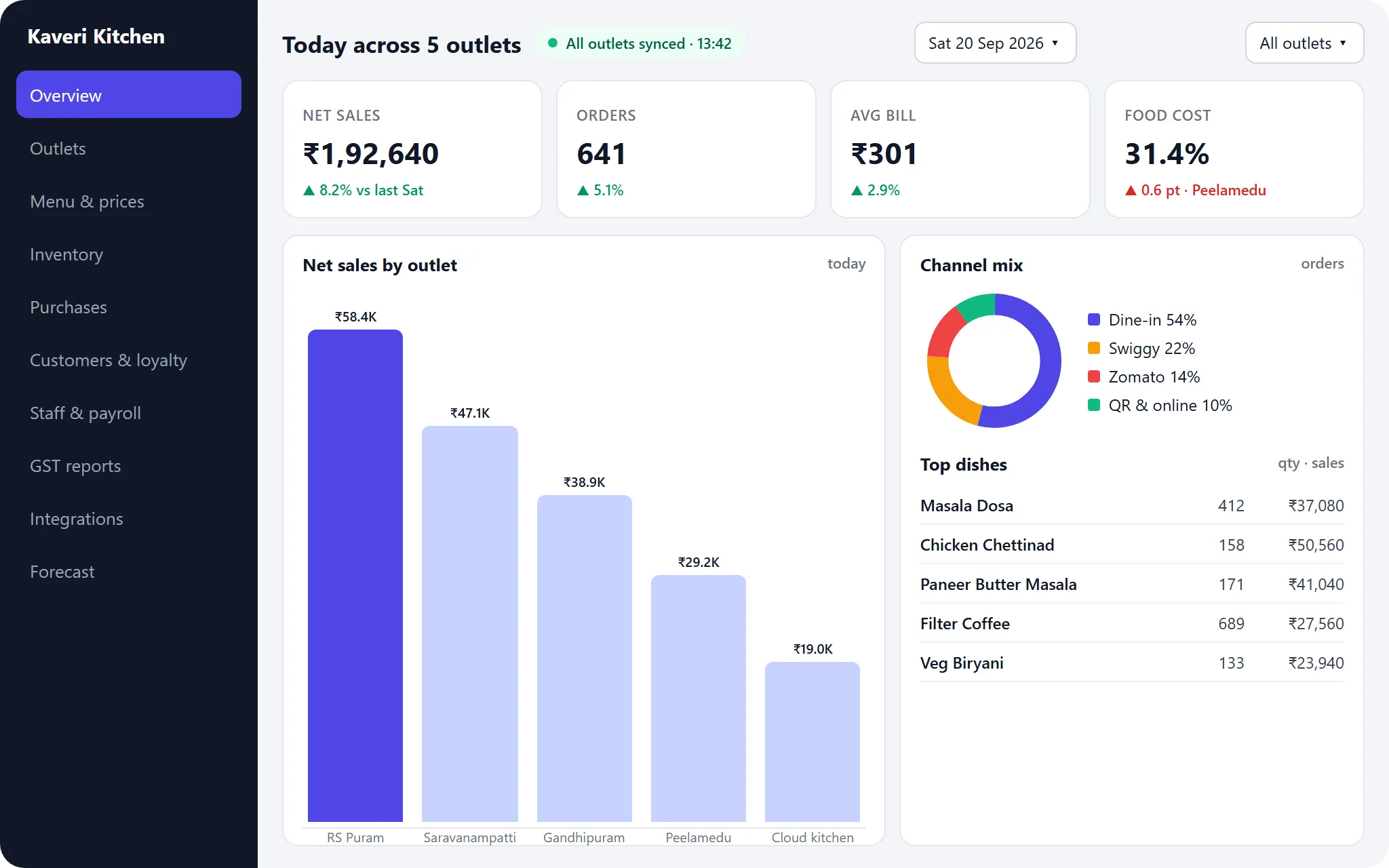
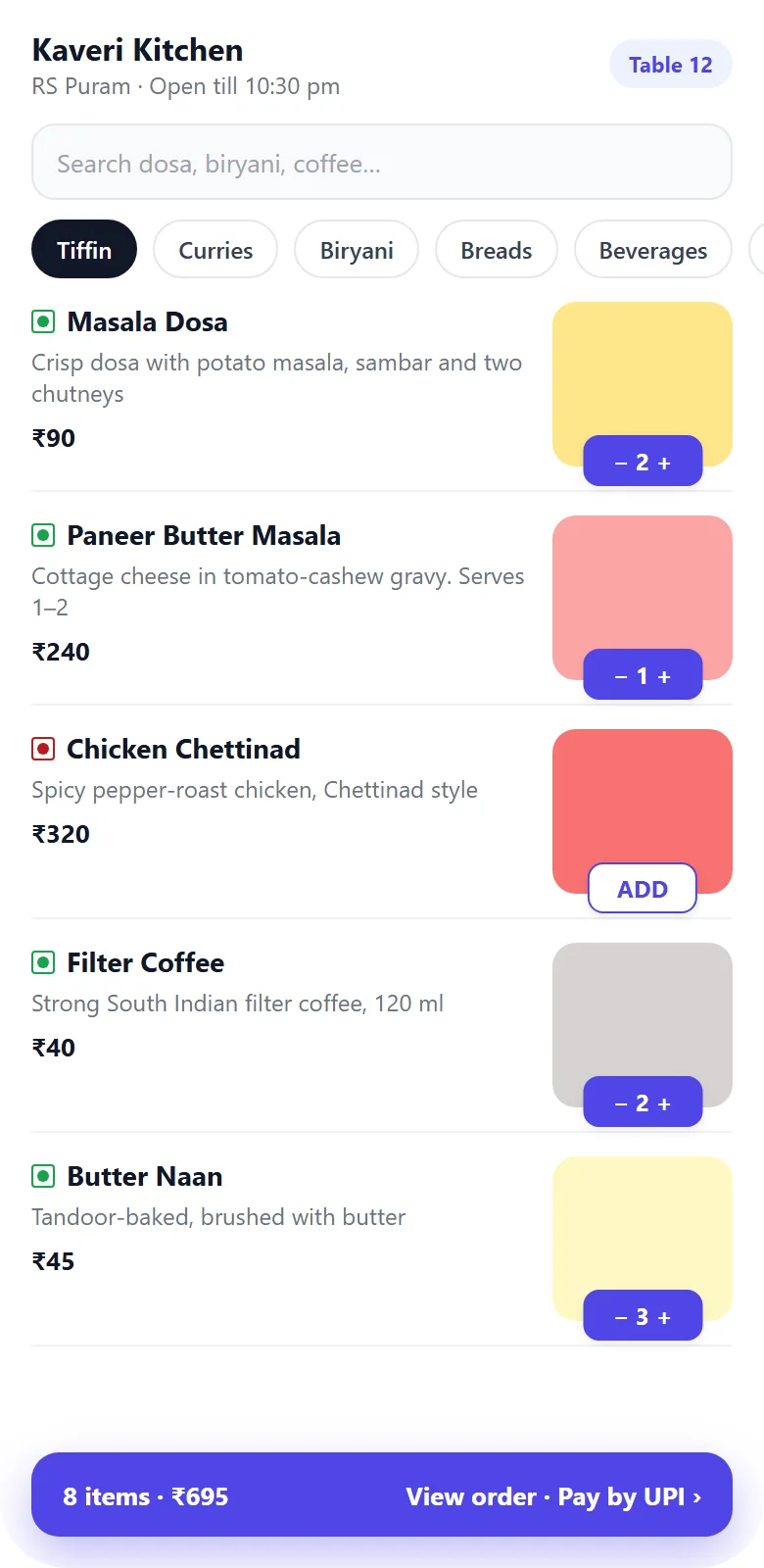
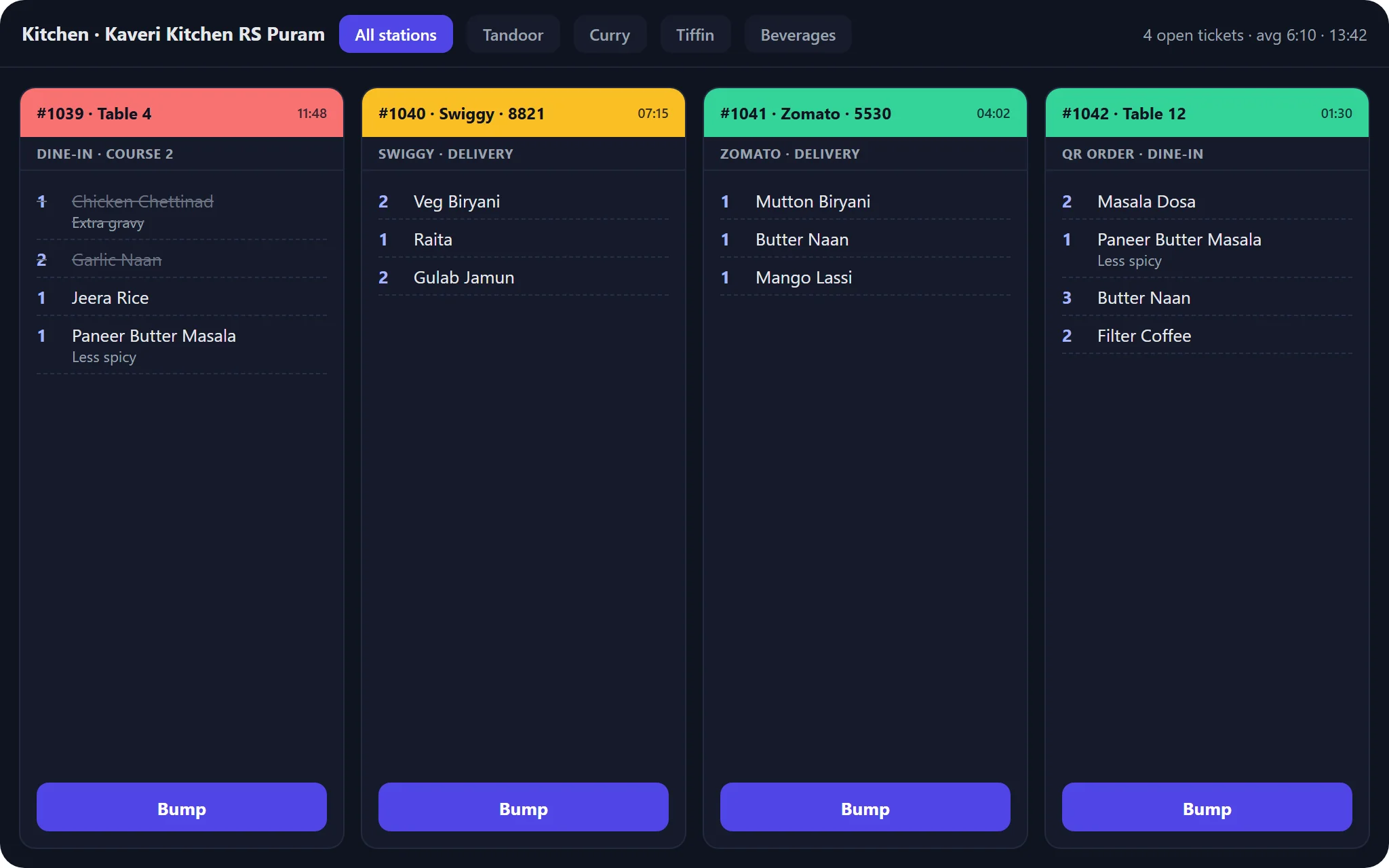
Illustrative screens of the four surfaces every restaurant system we build has: the billing counter, the kitchen display, the owner dashboard and guest-facing QR ordering. Fictional outlet and figures; your build carries your branding.

Restaurant POS billing counter screen with menu grid, cart, GST breakdown and payment buttons
Billing counter (tablet)Category rail, one-tap menu tiles, stock-out greyed, KOT sent to the kitchen, CGST/SGST split and cash, UPI or card settlement. The amber badge shows the terminal billing offline with three bills queued to sync.
Kitchen display system screen with four order tickets coloured by waiting time from dine-in, Swiggy, Zomato and QR orders
Kitchen display systemTickets from dine-in, Swiggy, Zomato and QR orders in one queue, colour-coded by wait time, with modifiers, course firing, bump and recall, and station filters for tandoor, curry, tiffin and beverages.
Multi-outlet restaurant dashboard with net sales, orders, average bill and food cost KPIs, sales by outlet bars, channel mix donut and top dishes table
Owner dashboard (multi-outlet)Net sales, orders, average bill and food-cost percentage across five outlets, sales by outlet, channel mix between dine-in and aggregators, top dishes, and a sync status line for every terminal.
QR table ordering screen on a phone with veg and non-veg menu items, add buttons and a view order and pay by UPI bar
QR table ordering (phone)Guests scan the table code, browse the live menu with veg and non-veg marks, add items and pay by UPI; the order lands in the same KDS queue as counter orders.

Golak's own product screens are on golak.store; the screens above are SpikeSecure illustrations, not Golak's interface.

Client

Golak: a restaurant operating system built and run from Coimbatore.

Golak is a SpikeSecure client and the clearest example of the restaurant POS architecture described above. Golak describes itself as "the complete restaurant operating system": billing, kitchen, stock, staff and growth on one fast, offline-ready platform. It is headquartered in Saravanampatti, Coimbatore, a few minutes from our office.

  • What the platform includes, as published on golak.store: cloud POS billing that works offline and syncs automatically, kitchen display system, inventory and recipe costing, QR ordering and own-domain online stores, CRM, loyalty and marketing campaigns, Golak Intelligence AI forecasting, staff attendance and payroll, multi-branch dashboards, and 46 modules in total.
  • Integrations: two-way Swiggy, Zomato and ONDC sync; Razorpay, PhonePe, Paytm, Google Pay and UPI payments; the official WhatsApp API and SMS; Tally, QuickBooks and Zoho Books; Google Sheets; a REST API and webhooks.
  • Hardware: Android and iPad tablets, phones, laptops, native Windows and macOS apps and the browser; HID barcode scanners, 58 mm and 80 mm receipt printers, kitchen printers, weight scales and cash drawers.
  • Commercials and scale, in Golak's own published figures: Starter ₹749 and Growth ₹1,874 per outlet per month, Enterprise on request, no per-terminal licences and no commission on sales; 180+ restaurant operators across 14 cities in Tamil Nadu, Kerala and Karnataka; a 4.9 rating from 180+ operators and 99.9% uptime.

Figures above are Golak's own, quoted from golak.store on 20 September 2026; we do not publish internal metrics for any client. If you want a restaurant POS for your own brand, or a white-label restaurant SaaS like Golak for your market, the sections below explain cost, timeline and process.

Restaurant POS software development cost in India

What restaurant POS software costs to build in India.

Indicative ranges, confirmed in a written fixed-scope quote after the discovery call. Compare with SaaS: Golak's published plans start at ₹749 per outlet per month, which is the right answer for many single outlets.

01

POS customisation — from ₹3 lakh

Your branding, menu logic, integrations and reports on top of an existing platform or open-source POS. 4–8 weeks. Right when the core billing flow already fits and you need Swiggy, Zomato, Tally or a loyalty module added.

02

Custom single-brand POS — ₹6–12 lakh

Billing apps, KDS, inventory and recipe costing, GST e-invoicing, payments and printer setup for one brand with a handful of outlets. 8–14 weeks, pilot outlet first.

03

Multi-branch restaurant OS — ₹12–30 lakh

Everything above plus central menu control, aggregator and ONDC sync, QR and online ordering, CRM and campaigns, payroll, multi-outlet dashboards and forecasting. 16–24 weeks with outlet-by-outlet rollout.

04

White-label restaurant SaaS — from ₹20 lakh

A multi-tenant platform you sell to other restaurants, with plans, billing, onboarding, per-tenant data isolation and an admin console, like Golak. Priced by module count and tenancy model.

05

What drives the number

Number of order channels and integrations, offline requirements, hardware variety, number of outlets and roles, payroll and accounting depth, and whether you need a public API for partners.

06

Ongoing costs to plan for

Cloud hosting (₹3,000–25,000 per month depending on outlets), payment gateway and WhatsApp API charges, aggregator API access, and optional maintenance from ₹15,000 per month with a monthly health report.

Related ranges on this site: ERP development from ₹2 lakh, food delivery platforms ₹4–30 lakh, mobile apps ₹4–20 lakh.

Where we build

Restaurant POS software development in Coimbatore, Chennai, Bengaluru and every major Indian city.

One Coimbatore team and the same process everywhere. What changes city to city is how we meet, which aggregators and payment habits dominate, and the local tax and labour rules the system has to encode.

Coimbatore, Tiruppur and the rest of Tamil Nadu

Our home market and Golak's. In-person discovery, counter and kitchen walk-throughs and hardware setup from our Saravanampatti office for restaurants, cafés, bakeries and cloud kitchens in Coimbatore, Tiruppur, Erode, Salem, Madurai and Trichy. Tamil and English interfaces for billing staff and kitchen screens.

Chennai

On-site kick-off in Chennai on request, then weekly remote demos. QSR chains, food courts, hotel F&B and cloud-kitchen brands with several outlets across OMR, Anna Nagar, T. Nagar and Velachery usually need the multi-branch layer and aggregator sync from day one.

Bengaluru and Hyderabad

Cloud kitchens, café chains and tech-forward restaurant brands that want an API-first system, integrations with their own apps and analytics, and Kannada, Telugu or Hindi interfaces alongside English. Delivered remotely with an on-site visit for the pilot outlet launch.

Mumbai and Pune

High-volume counters, bars and multi-cuisine restaurants where offline resilience, split billing, service charge handling and fast thermal printing matter most, with Marathi and Hindi support. Remote delivery with rollout support during launch week.

Delhi NCR

Restaurant groups and franchise brands across Delhi, Gurugram and Noida that need central menu control, franchise-level royalty and settlement reports, and multi-outlet GST compliance across states. Remote delivery; on-site training for franchise managers on request.

Kolkata, Ahmedabad, Kochi and other cities

Everything is delivered remotely: discovery on video, weekly demos on a staging URL, remote printer and hardware configuration, and recorded training in your team's language. The build, the warranty and the price are the same wherever your outlets are. See how hiring developers in India works for teams outside Tamil Nadu.

AI visibility and SEO reach

A restaurant system that also gets your outlets found.

The POS holds the truth about your menu, prices, hours and outlets. We wire that truth into the places customers and AI assistants look, so marketing runs off the same data as the kitchen.

01

Own-domain ordering store built for search

Each outlet gets a fast, indexable ordering page with Restaurant, Menu, MenuItem and Offer schema, clean city and locality URLs, and Core Web Vitals targets, so you rank for your dish and area rather than only appearing inside an aggregator app.

02

Google Business Profile in sync

Menu items, prices, hours, holiday closures and new outlets pushed from the POS to Google Business Profile, so Maps, Search and AI Overviews show what the counter shows.

03

Answer engine ready

An llms.txt file, FAQ schema and direct-answer content per outlet so ChatGPT, Gemini, Perplexity and Copilot can answer questions like what a brand serves, where it is and whether it delivers. Our AEO specialist team handles this.

04

Reviews and loyalty loops

Post-bill WhatsApp messages that ask for a Google review from happy diners and re-engage lapsed customers from CRM data, with consent handling built into the flow.

05

Aggregator and ONDC reach

Two-way Swiggy, Zomato and ONDC sync keeps menus and stock-outs accurate across every listing, which protects ratings and prevents cancelled orders.

06

Analytics that close the loop

GA4 and Search Console for the ordering store, order attribution by channel, and dashboards that show which dishes, offers and localities bring repeat orders.

Buying guide

Custom POS, SaaS or both?

Most restaurants should not build a POS from scratch. Here is how we advise clients, honestly:

  • Single outlet or a small chain with standard needs. Subscribe to a restaurant SaaS. Golak's published plans start at ₹749 per outlet per month, and comparable platforms such as Petpooja and Posist exist nationally. Custom development cannot beat that price for standard billing.
  • A brand with a process the SaaS cannot model. Central kitchens feeding outlets, franchise settlement, unusual pricing rules, hotel PMS or club membership integration, or regulatory reporting. Here a custom POS or a deep customisation on top of a platform pays for itself.
  • A company that wants to sell restaurant software. A white-label, multi-tenant restaurant SaaS for a city, cuisine, franchise network or country. This is product development, not IT; it needs plans, onboarding, support tooling and an API from day one.
  • A group already on a SaaS that needs more. Keep the SaaS for billing and build the missing pieces around its API: a customer app, loyalty engine, central purchasing, HR or BI, integrated through webhooks and scheduled sync.

In the discovery call we tell you which of the four you are, and we will say so if the answer is a subscription rather than a build.

Our stack

Technologies we build restaurant POS software with.

  • Flutter
  • React Native
  • Electron
  • Next.js
  • React
  • Node.js
  • NestJS
  • PostgreSQL
  • SQLite (offline)
  • Redis
  • WebSockets
  • AWS Mumbai
  • Razorpay
  • PhonePe
  • WhatsApp Business API
  • ESC/POS printing
  • Swiggy / Zomato APIs
  • ONDC
  • Tally
  • Zoho Books

Read how we choose between them on our technologies page: Flutter for tablet and phone POS apps from one codebase, Electron or native for desktop counters, Node.js and NestJS for the sync and integration layer.

How we work

Our restaurant POS development process, outlet by outlet.

The same six steps for a single café and a multi-city chain; only the rollout phase gets longer.

01

Discovery — week 1

We sit at your counter and in your kitchen (in person in Tamil Nadu, on video elsewhere), map every order type, menu rule, discount, tax case and report you use today, and send a fixed-scope written quote within 48 hours of the last session.

02

Design — weeks 2–3

Billing, KDS and back-office screens as a clickable prototype, tested with your cashiers and kitchen staff before any code, including the offline and printer-failure cases.

03

Build — week 3 onwards

POS apps, KDS, sync engine, integrations and back office in weekly demos on a staging URL, with GitHub access from day one. Printers, drawers and scanners are tested against your actual hardware.

04

Pilot — one outlet

Data migration from your current billing software, staff training, and a live pilot outlet for two to four weeks with daily check-ins while we tune workflows.

05

Rollout — remaining outlets

Outlet-by-outlet launch with central menu control, hardware setup checklists and remote support; multi-city chains get a rollout calendar and a named launch contact.

06

Support — ongoing

30-day warranty, then optional maintenance from ₹15,000 per month covering updates, aggregator API changes, GST rule changes, backups and a monthly health report.

FAQ

Restaurant POS software development: your questions answered.

What is restaurant POS software?

Restaurant POS (point of sale) software is the system that takes orders, sends them to the kitchen, prints bills, records payments and reports sales for a restaurant. Modern restaurant POS platforms, often called restaurant operating systems, add kitchen display screens, inventory and recipe costing, online and QR ordering, aggregator integrations, CRM and loyalty, payroll and multi-outlet dashboards on the same data.

How much does restaurant POS software development cost in India?

Indicatively, POS customisation on an existing platform costs from ₹3 lakh, a custom single-brand POS with billing, KDS and inventory ₹6–12 lakh, a multi-branch restaurant operating system ₹12–30 lakh, and a white-label restaurant SaaS from ₹20 lakh. For a single outlet with standard needs, a subscription such as Golak's published ₹749 per outlet per month plan is usually the better answer. Every SpikeSecure engagement is confirmed in a fixed-scope written quote.

How long does it take to build a restaurant POS?

POS customisation takes 4–8 weeks, a custom POS with KDS and inventory 8–14 weeks, and a multi-branch restaurant OS 16–24 weeks. We launch a pilot outlet first, run it for two to four weeks, then roll out to the remaining outlets on a calendar.

Does the POS work without internet?

Yes. We build offline-first: the terminal keeps a local database, so orders, KOTs, bills and payments continue during an outage and sync automatically when the connection returns, with conflict handling for stock and table state. Golak, our client, ships the same offline-capable billing.

Can you integrate Swiggy, Zomato and ONDC?

Yes. Two-way integration pushes menus, prices and stock-outs to Swiggy, Zomato and ONDC and pulls orders into the same KDS queue as dine-in orders, with status updates flowing back. Aggregator API access is arranged through your merchant accounts.

Is GST e-invoicing and reporting included?

Yes. GST-compliant invoices with HSN/SAC codes, e-invoicing where your turnover requires it, service-charge and tax handling per item, and returns-ready reports, plus sync to Tally, QuickBooks or Zoho Books so your accountant works from the same numbers.

Which hardware does the POS support?

Android tablets, iPads, phones, Windows and macOS desktops and the browser for terminals; 58 mm and 80 mm thermal receipt printers, kitchen printers, HID barcode scanners, weight scales and cash drawers. We test against your actual devices before launch and supply a hardware checklist for new outlets.

Cloud POS or on-premise?

Cloud with offline-first terminals suits almost every restaurant: central control, automatic updates and multi-outlet reporting, with billing that survives outages. Fully on-premise deployments are possible for hotels or campuses with strict network policies, at higher hosting and maintenance cost.

Can you build multi-branch and franchise features?

Yes. Central menu and price management, outlet-level permissions, consolidated and per-outlet dashboards, inter-branch stock transfers, central kitchen supply, and franchise royalty and settlement reports across states and GST registrations.

Should we build a custom POS or subscribe to a SaaS?

Subscribe if you are a single outlet or small chain with standard needs; Golak's plans start at ₹749 per outlet per month. Build or customise if your process cannot be modelled by a SaaS, if you need deep integrations with hotel, club or franchise systems, or if you intend to sell restaurant software yourself. We tell you which in the discovery call.

Can you build a white-label restaurant SaaS like Golak?

Yes. A multi-tenant platform with subscription plans, tenant onboarding, per-tenant data isolation, an admin console, support tooling and a public API, priced from ₹20 lakh depending on module count and tenancy model. Golak, our client, is an example of this category of product.

Do you build restaurant POS software for cities outside Tamil Nadu?

Yes. Coimbatore, Chennai and Tiruppur are served in person; Bengaluru, Hyderabad, Mumbai, Pune, Delhi NCR, Kolkata, Ahmedabad, Kochi and every other Indian city remotely, with on-site kick-off and pilot-launch visits on request. The process, warranty and pricing are the same everywhere.

Who owns the code and data?

You do. Source code in your GitHub organisation, cloud accounts, app store listings and databases in your name from day one, with documentation and a recorded handover. Custom builds carry no per-terminal licences.

Can the POS help my restaurant get found on Google and AI assistants?

Yes. We build an own-domain ordering store with Restaurant and Menu schema, keep Google Business Profile in sync with POS menu and hours data, publish llms.txt and FAQ content per outlet, and run review and loyalty loops over WhatsApp. Our AEO and SEO teams can run this as a retainer after launch.

How do I get started?

Email your outlet count, current billing software, the channels you sell through and the integrations you need to info@spikesecure.com, or WhatsApp +91 95149 94888. We schedule a discovery session at your counter or on video and send a fixed-scope written quote, usually within 48 hours.
Let's build

Ready to run every outleton one restaurant system?

A 30-minute discovery call and a fixed-scope quote — usually within 48 hours. No deck, no sales theatre.

Or email our team at info@spikesecure.com · give us a call at +91 95149 94888 · WhatsApp