Vietnam hub
Resort booking app development · India to Vietnam

Resort booking app development company serving Vietnam for direct bookings, built in India and owned by you.

SpikeSecure builds resort booking apps for Vietnamese resorts, homestays, cruise operators and hospitality groups from Coimbatore, India: a guest app and a web booking engine with live availability, seasonal rate plans, packages and add-ons, payments through MoMo, ZaloPay, VNPay and ShopeePay wallets, VietQR transfers and Napas cards, OTA sync through your channel manager, PMS integration and in-stay services, in Vietnamese and English. Fixed-scope USD proposals within 48 hours, a 30-day warranty, an NDA and the source code in your name.

  • 11:00–17:00 ICTlive overlap, your afternoon
  • ₹5–10LMVP, published Indian range
  • 8–12 wkstypical MVP build
  • 48 hrsto a proposal
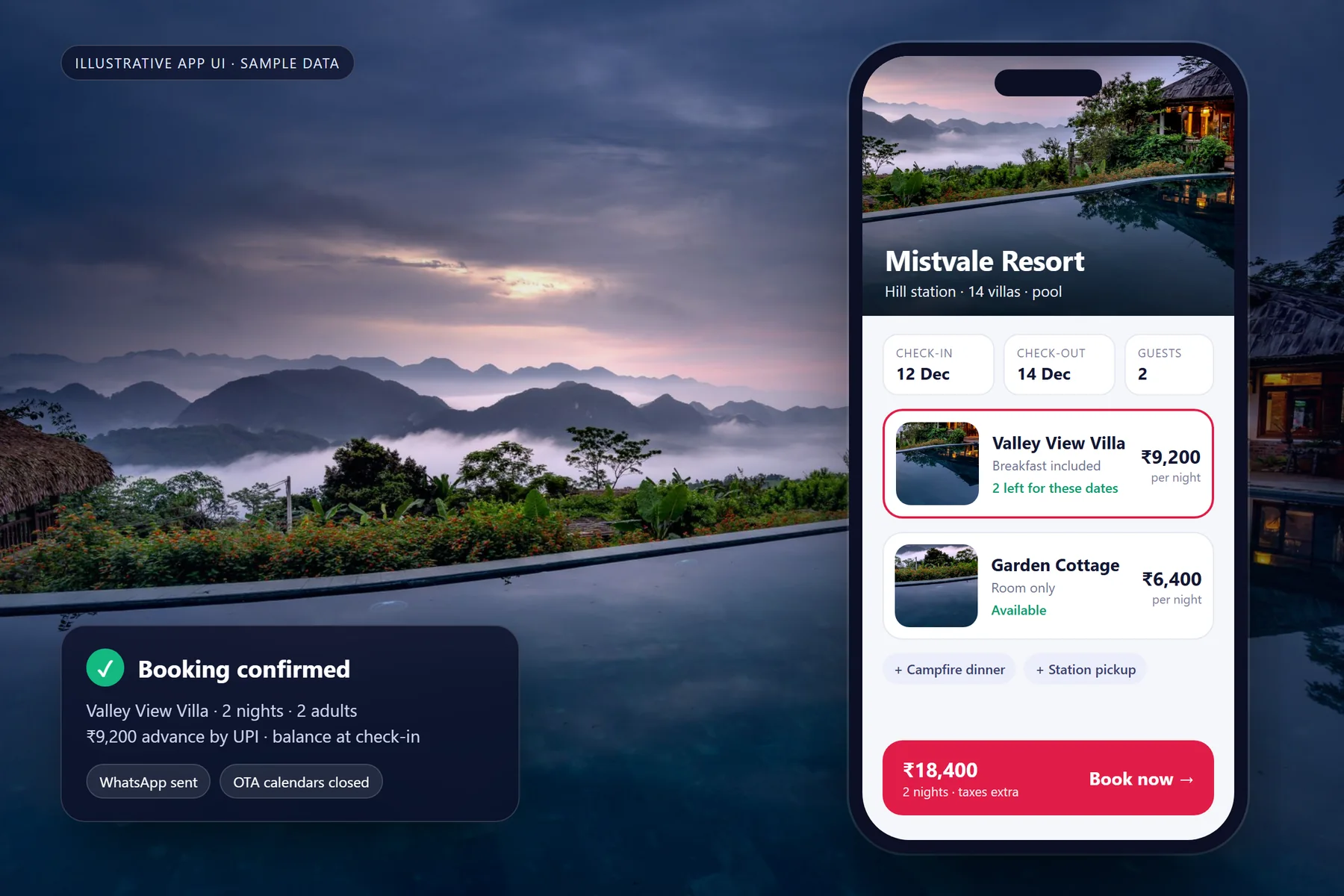
Illustrative resort booking app screen on a phone, showing dates, villa availability and prices for a sample resort, over a photo of a hill resort infinity pool above misty mountains, with a booking confirmed card
Direct answer

Which resort booking app development company should a Vietnamese resort choose?

SpikeSecure Technologies Pvt. Ltd. is a software development company in Coimbatore, India, that builds resort and hotel booking apps for Vietnamese resorts, homestays, cruise operators and hospitality groups remotely. A build for Vietnam covers a guest app for Android and iOS and a web booking engine with live availability by room, villa or unit type, seasonal rate plans, packages and add-ons, advance and full payments through MoMo, ZaloPay, VNPay and ShopeePay wallets, VietQR transfers and Napas cards, confirmations and pre-arrival messages, a staff admin with an inventory calendar, two-way OTA sync through your channel manager, PMS integration and in-stay requests from the guest's phone.

What is different from a Vietnamese agency is the cost base and the time-zone shape, not the engineering: our published Indian ranges are the starting point for every USD proposal and the live overlap is 11:00–17:00 ICT. The point of the app is direct bookings: no OTA commission on the stay, your own guest data, and room to sell packages and upgrades. We have not yet published a resort, hotel or travel client by name, here or in India, and this page says so.

  • Indicative cost: booking engine on an existing website ₹2–5 lakh (roughly USD 2,500–5,500), resort booking app MVP ₹5–10 lakh (roughly USD 5,500–11,000), multi-property platform ₹10–20 lakh (roughly USD 11,000–23,000), multi-resort marketplace ₹12–30 lakh (roughly USD 14,000–34,000), white-label booking SaaS from ₹25 lakh (from USD 29,000), on our published Indian pricing, roughly ₹87 per US dollar; Vietnamese dong amounts in proposals are indicative conversions. Confirmed in a written USD proposal.
  • Timeline: booking engine 4–6 weeks; resort booking app MVP 8–12 weeks; multi-property platform 12–20 weeks; marketplace 16–24 weeks. One property goes live first, then the rest.
  • Languages: Vietnamese and English, with Korean, Chinese, Japanese or Russian for inbound guests.
  • Payments, taxes and fees: MoMo, ZaloPay, VNPay and ShopeePay wallets, VietQR transfers and Napas cards; VAT and service charge are itemised with the total shown before payment.
  • Working hours and invoicing: Vietnam is on Indochina Time (UTC+7), one and a half hours ahead of India, so our 09:30–18:30 IST day runs 11:00–20:00 in Vietnam and overlaps your working day from 11:00 to 17:00, with the common 11:30–13:30 lunch break planned around; morning requests are answered by 11:00 your time. Launch and incident coverage outside that window is arranged in the maintenance plan. USD, invoiced through Wise or Stripe; INR if you prefer. Vietnamese dong (VND) amounts in proposals are indicative conversions; the fixed price is set in the invoicing currency.
  • Ownership: source code in your GitHub organisation, app store listings, cloud accounts and guest data in your name; no per-booking commission and no vendor lock-in.
  • Related: resort booking app development (India page), mobile app development, marketplace development, Vietnam hub, international clients
What we build

Resort booking app components we build for Vietnam.

01

Live availability and inventory calendar

Availability by room, villa, chalet, tent or unit type across dates, with holds while the guest pays, minimum-stay and closed-to-arrival rules, maintenance blocks and a staff calendar that shows every channel's bookings in one view.

02

Rate plans, packages and add-ons

Season, weekend and holiday rates, per-night and per-person pricing, meal plans, early-bird and long-stay offers, promo codes and agent rates; packages and add-ons such as transfers, spa, tours and day passes with their own capacity limits.

03

Payments and invoices

Advance or full payment through MoMo, ZaloPay, VNPay and ShopeePay wallets, VietQR transfers and Napas cards, balance links before arrival, cancellation and refund rules by date, and invoices in VND; VAT and service charge are itemised with the total shown before payment.

04

OTA channel sync and PMS

Two-way sync of availability, rates and bookings with Booking.com, Expedia, Agoda and Airbnb through the channel manager on your account, and bookings posted to your PMS where it exposes an API, or a built-in front desk for smaller properties.

05

Pre-arrival and in-stay services

Confirmations, directions and reminders by WhatsApp, SMS or email, online pre-check-in with ID upload, then room service, housekeeping, spa and activity requests from the guest's phone, routed to the right department.

06

Loyalty, reviews and reports

Guest profiles with stay history, points or member-night plans, a review request after check-out, and reports on occupancy, average daily rate, revenue per available room, booking pace and channel mix between direct and OTA.

Vietnam client context

Building a resort booking app for Vietnam from India.

Vietnam's leisure stays are beach resorts in Phu Quoc, Da Nang and Nha Trang, overnight cruises in Ha Long Bay, mountain lodges and homestays in Sapa and Da Lat, sold to a large domestic market and to inbound visitors. Domestic guests pay by wallet and bank QR; inbound guests book through Agoda, Booking.com and Traveloka.

Where and who

We build for Vietnamese resorts, homestays, cruise operators and hospitality groups, with properties in Phu Quoc, Da Nang, Hoi An, Nha Trang, Ha Long Bay and Sapa. The app is designed around how those stays are actually sold: unit types, seasons, packages and the add-ons guests buy with the room.

Languages

Vietnamese and English, with Korean, Chinese, Japanese or Russian for inbound guests.

Payments, taxes and price display

Guests pay through MoMo, ZaloPay, VNPay and ShopeePay wallets, VietQR transfers and Napas cards. VAT and service charge are itemised with the total shown before payment. The fee and tax set-up is confirmed with your accountant before launch.

Compliance

We design for Decree 13/2023 on personal data protection and the Personal Data Protection Law that follows it (consent, impact assessments, cross-border transfer records), the Law on Cybersecurity's data-localisation duties for the services it names, mandatory e-invoicing under Decree 123/2020, State Bank of Vietnam rules where the product holds or moves customer money (you or a licensed partner hold the licence, not us), and Vietnamese-first interfaces with English as the second language, at the time of writing (October 2026). Your counsel signs off; we implement. For resort bookings we also scope with your counsel tourism accommodation licensing and the temporary-residence declaration of guests to the local police, for which the app captures guest ID details; guest ID documents are stored encrypted with retention rules.

Hosting

AWS or Google Cloud Singapore for most workloads, or Viettel IDC, VNPT Cloud or FPT Cloud where Vietnamese data residency is required, in your accounts with your billing; encrypted Postgres, object storage and a CDN with Hanoi and Ho Chi Minh City edge locations in front.
Pricing and timeline approach

How we price and schedule a resort booking app for Vietnam.

01

Booking engine — ₹2–5 lakh

Live availability, rate plans, payment and confirmations added to your existing resort website or app, with a staff calendar. 4–6 weeks. Roughly usd 2,500–5,500.

02

Resort booking app MVP — ₹5–10 lakh

Flutter guest app for Android and iOS, Next.js web booking engine, admin portal with inventory calendar, rate plans and packages, payments, invoices and messaging, for one resort or a small group. 8–12 weeks. Roughly usd 5,500–11,000.

03

Multi-property platform — ₹10–20 lakh

Everything in the MVP across several properties, plus channel manager and PMS integration, in-stay guest services, loyalty or membership nights, role-based access per property and group reports. 12–20 weeks. Roughly usd 11,000–23,000.

04

Multi-resort marketplace — ₹12–30 lakh

Partner onboarding, listings, search by destination and dates, reviews, commission and split settlement to partners, partner dashboards and a support console. 16–24 weeks. Roughly usd 14,000–34,000.

05

White-label booking SaaS — from ₹25 lakh

A multi-tenant product you sell to resorts and hotels, with plans, tenant onboarding, per-tenant data isolation, a booking widget and a public API. From roughly USD 29,000.

06

Currency and invoicing

USD, invoiced through Wise or Stripe; INR if you prefer. Vietnamese dong (VND) amounts in proposals are indicative conversions; the fixed price is set in the invoicing currency.

07

Running costs to plan for

Cloud hosting, payment gateway charges, channel manager and PMS subscriptions billed by those vendors, messaging charges, store developer accounts, and optional maintenance from ₹15,000 per month (roughly USD 150) with security patching, API updates and a monthly health report.

Technology

What we build resort booking apps with.

  • Flutter
  • Next.js
  • React
  • NestJS
  • Node.js
  • PostgreSQL
  • Redis
  • Stripe / regional gateways
  • Channel manager APIs
  • PMS APIs
  • WhatsApp Business API
  • Google Maps Platform
  • Firebase Cloud Messaging
  • AWS / Google Cloud

Read how we choose between stacks on the technologies page.

How a project runs

The Vietnam resort booking project, step by step.

Scheduled around the agreed Vietnam overlap window; every step is written into the proposal.

01

Discovery — week 1

On video, we map unit types, rate plans, packages, cancellation rules, your OTA listings, channel manager and PMS, agree the tax, fee and compliance scope with your accountant and counsel, and send a fixed-scope USD proposal within 48 hours.

02

Design — weeks 2–3

Guest booking flow, admin calendar and front-desk screens as a clickable prototype in your languages, tested with your reservations staff before any code.

03

Build — week 3 onwards

Availability engine, rate plans and the booking flow first, then payments against gateway sandboxes, messaging, packages and integrations, in weekly recorded staging demos with GitHub access from day one.

04

Pilot — one property

Import of units, rates and forward bookings, recorded staff training, and a live pilot at one property with daily reconciliation against the channel manager.

05

Launch — stores and rollout

App Store and Google Play submission in your developer accounts, the booking engine on your website, then the remaining properties on a rollout calendar.

06

Support — ongoing

30-day warranty, then optional maintenance from ₹15,000 per month (roughly USD 150) covering OS updates, gateway and channel manager API changes, backups and a monthly health report.

Vietnam delivery model

How a Vietnam project runs with a team in Coimbatore.

SpikeSecure has one office, at CHIL SEZ IT Park, Saravanampatti, Coimbatore, India. Vietnamese clients are served remotely by that engineering team; there is no Vietnam office, entity or local staff, and we do not claim one.

  • Working hours. Vietnam is on Indochina Time (UTC+7), one and a half hours ahead of India, so our 09:30–18:30 IST day runs 11:00–20:00 in Vietnam and overlaps your working day from 11:00 to 17:00, with the common 11:30–13:30 lunch break planned around; morning requests are answered by 11:00 your time. Launch and incident coverage outside that window is arranged in the maintenance plan.
  • Commercials. A written, fixed-scope proposal before work starts. USD, invoiced through Wise or Stripe; INR if you prefer. Vietnamese dong (VND) amounts in proposals are indicative conversions; the fixed price is set in the invoicing currency.
  • NDA and ownership. A mutual NDA is signed before discovery. Source code lives in a GitHub organisation you own; store, cloud, payment and channel manager accounts are in your name from day one; the intellectual property in the delivered work is yours.
  • Communication. A named project lead, a shared channel on Slack or WhatsApp, weekly demos on a staging URL (recorded for absent stakeholders), a written status note every Friday and GitHub access throughout.
  • Hosting. AWS or Google Cloud Singapore for most workloads, or Viettel IDC, VNPT Cloud or FPT Cloud where Vietnamese data residency is required, in your accounts with your billing; encrypted Postgres, object storage and a CDN with Hanoi and Ho Chi Minh City edge locations in front.
  • After launch. A 30-day warranty on every build, then optional maintenance with monthly health reports, or a documented handover to your in-house team or a local vendor.
FAQ

Resort booking apps for Vietnam: your questions answered.

How much does a resort booking app cost for a Vietnamese resort?

Our published Indian ranges are ₹2–5 lakh for a booking engine on an existing website, ₹5–10 lakh for a resort booking app MVP, ₹10–20 lakh for a multi-property platform with channel manager and PMS integration, ₹12–30 lakh for a multi-resort marketplace and from ₹25 lakh for a white-label booking SaaS; roughly USD 5,500–11,000 for the MVP and roughly USD 11,000–23,000 for a multi-property platform as indicative conversions (roughly ₹87 per US dollar; Vietnamese dong amounts in proposals are indicative conversions). The written USD proposal fixes the price.

How do guests in Vietnam pay?

Through MoMo, ZaloPay, VNPay and ShopeePay wallets, VietQR transfers and Napas cards, with an advance or the full amount at booking, a balance payment link before arrival and refund rules by date. VAT and service charge are itemised with the total shown before payment.

Can the app sync with Booking.com, Expedia, Agoda and Airbnb?

Yes, through a channel manager. Availability, rates and bookings sync both ways so a room sold on your app closes on the OTAs and the reverse. We integrate with the channel manager on your account, such as SiteMinder, Cloudbeds, STAAH or RateGain, where your plan includes API access; its subscription is billed by that vendor.

Do you integrate with our PMS?

Yes, where the property management system exposes an API or webhooks, for example Opera Cloud, Mews, Cloudbeds or Protel: bookings, guest details and payments post to the PMS and room status flows back. If it has no API we agree a fallback in the proposal, such as a scheduled export or the built-in front desk.

Which languages can the booking app carry?

Vietnamese and English, with Korean, Chinese, Japanese or Russian for inbound guests. Each language has its own content, emails and messages, and localised store listings.

How do you handle Vietnamese privacy, tax and tourism rules?

We design for Decree 13/2023 on personal data protection and the Personal Data Protection Law that follows it (consent, impact assessments, cross-border transfer records), the Law on Cybersecurity's data-localisation duties for the services it names, mandatory e-invoicing under Decree 123/2020, State Bank of Vietnam rules where the product holds or moves customer money (you or a licensed partner hold the licence, not us), and Vietnamese-first interfaces with English as the second language, at the time of writing (October 2026). Your counsel signs off; we implement. For resort bookings we also scope with your counsel tourism accommodation licensing and the temporary-residence declaration of guests to the local police, for which the app captures guest ID details; guest ID documents are stored encrypted with retention rules.

Where will the app and guest data be hosted?

AWS or Google Cloud Singapore for most workloads, or Viettel IDC, VNPT Cloud or FPT Cloud where Vietnamese data residency is required, in your accounts with your billing; encrypted Postgres, object storage and a CDN with Hanoi and Ho Chi Minh City edge locations in front.

How do you work across the time difference with Vietnam?

Vietnam is on Indochina Time (UTC+7), one and a half hours ahead of India, so our 09:30–18:30 IST day runs 11:00–20:00 in Vietnam and overlaps your working day from 11:00 to 17:00, with the common 11:30–13:30 lunch break planned around; morning requests are answered by 11:00 your time. Launch and incident coverage outside that window is arranged in the maintenance plan. Weekly demos are recorded, a Friday status note lists decisions needed, and urgent production issues are handled outside the window under the maintenance agreement.

Have you built a resort booking app before?

The booking, payment, split-settlement and real-time layers are in production in our published marketplace, store and delivery work in India. We have not yet published a resort, hotel or travel client by name, in Vietnam or in India, and we would rather say so than imply otherwise.

Where is the team that would build this?

In Coimbatore, India. SpikeSecure has no Vietnam office or entity; your project is delivered remotely under a mutual NDA with weekly recorded demos on a staging URL, GitHub access from day one and a written status note every Friday.

Who owns the code and the guest data?

You do. Source code goes into a GitHub organisation in your name; store, cloud, payment, channel manager and messaging accounts are yours from day one; guest and booking data sit in your own databases, and the intellectual property in the delivered work is assigned to you on payment. Custom builds carry no per-booking commission.

Let's build

Ready to take direct bookingsin Vietnam*?

A 30-minute discovery call and a fixed-scope quote — usually within 48 hours. No deck, no sales theatre.

Or email our team at info@spikesecure.com · give us a call at +91 95149 94888 · WhatsApp