USA hub
Resort booking app development · India to the USA

Resort booking app development company serving the USA for direct bookings, built in India and owned by you.

SpikeSecure builds resort booking apps for US resorts, lodges, glamping sites, ski properties and vacation-rental operators from Coimbatore, India: a guest app and a web booking engine with live availability, seasonal rate plans, packages and add-ons, payments through Stripe with cards, Apple Pay and Google Pay, OTA sync through your channel manager, PMS integration and in-stay services, in English and Spanish. Fixed-scope USD proposals within 48 hours, a 30-day warranty, an NDA and the source code in your name.

  • 08:00–10:00 ETagreed daily live window
  • ₹5–10LMVP, published Indian range
  • 8–12 wkstypical MVP build
  • 48 hrsto a proposal
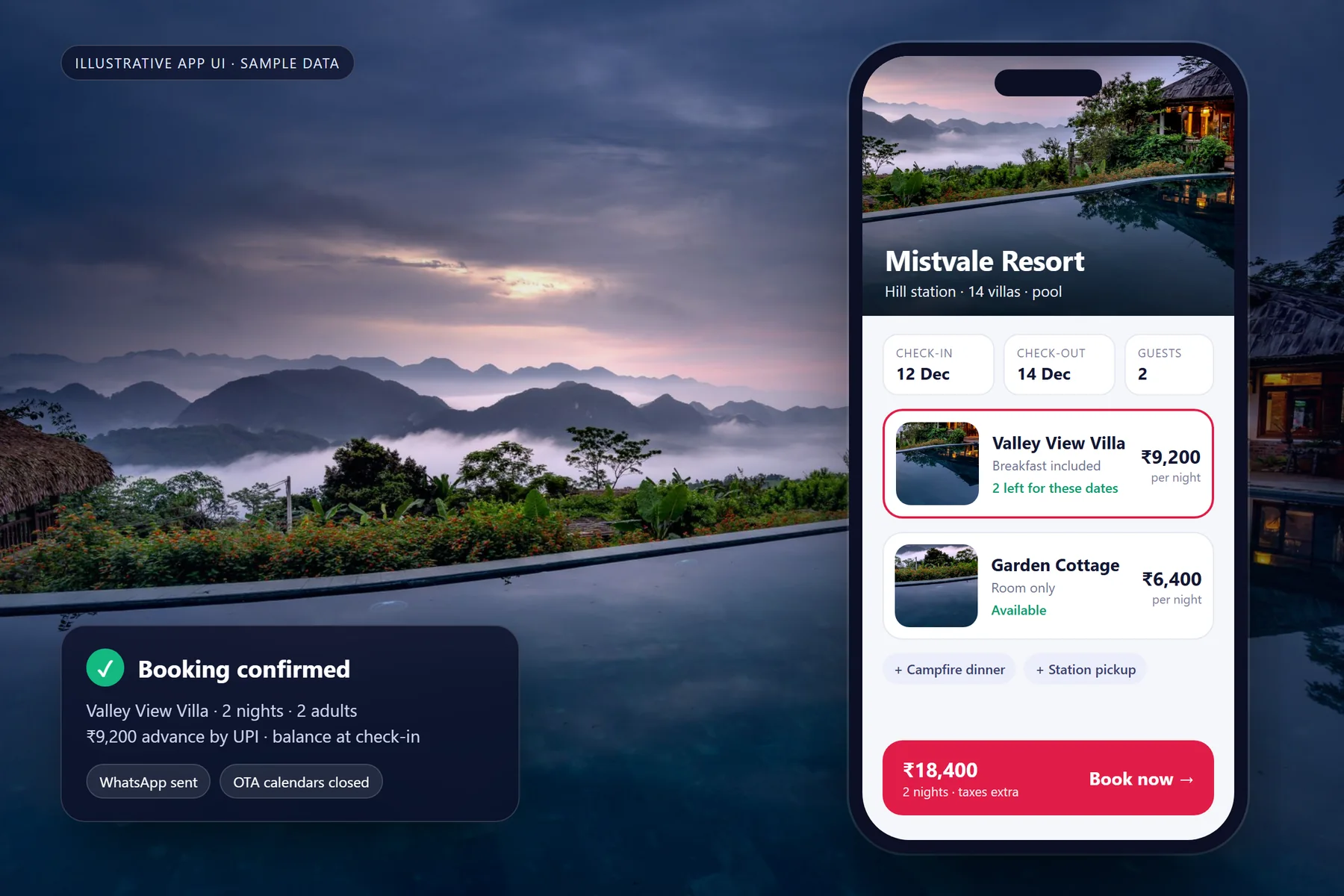
Illustrative resort booking app screen on a phone, showing dates, villa availability and prices for a sample resort, over a photo of a hill resort infinity pool above misty mountains, with a booking confirmed card
Direct answer

Which resort booking app development company should a US resort choose?

SpikeSecure Technologies Pvt. Ltd. is a software development company in Coimbatore, India, that builds resort and hotel booking apps for US resorts, lodges, glamping sites, ski properties and vacation-rental operators remotely. A build for the USA covers a guest app for Android and iOS and a web booking engine with live availability by room, villa or unit type, seasonal rate plans, packages and add-ons, advance and full payments through Stripe with cards, Apple Pay and Google Pay, confirmations and pre-arrival messages, a staff admin with an inventory calendar, two-way OTA sync through your channel manager, PMS integration and in-stay requests from the guest's phone.

What is different from a US agency is the cost base and the time-zone shape, not the engineering: our published Indian ranges are the starting point for every USD proposal and the live overlap is 08:00–10:00 ET. The point of the app is direct bookings: no OTA commission on the stay, your own guest data, and room to sell packages and upgrades. We have not yet published a resort, hotel or travel client by name, here or in India, and this page says so.

  • Indicative cost: booking engine on an existing website ₹2–5 lakh (roughly USD 2,500–5,500), resort booking app MVP ₹5–10 lakh (roughly USD 5,500–11,000), multi-property platform ₹10–20 lakh (roughly USD 11,000–23,000), multi-resort marketplace ₹12–30 lakh (roughly USD 14,000–34,000), white-label booking SaaS from ₹25 lakh (from USD 29,000), on our published Indian pricing, roughly ₹87 per US dollar. Confirmed in a written USD proposal.
  • Timeline: booking engine 4–6 weeks; resort booking app MVP 8–12 weeks; multi-property platform 12–20 weeks; marketplace 16–24 weeks. One property goes live first, then the rest.
  • Languages: English and Spanish.
  • Payments, taxes and fees: Stripe with cards, Apple Pay and Google Pay; state and local lodging taxes and any resort fee are included in the total price shown from the first screen, which is how we read the FTC's rule on unfair or deceptive fees for short-term lodging.
  • Working hours and invoicing: Our office hours of 09:30–18:30 IST are 00:00–09:00 Eastern (23:00–08:00 during standard time) and 21:00–06:00 Pacific, so the live overlap with a US business day is short: we agree a daily window in the proposal, typically 08:00–10:00 Eastern for stand-ups and demos, and run the rest asynchronously with written updates you read at the start of your day. Evening coverage in India for launches and incidents is arranged in the maintenance plan. USD, invoiced through Stripe or Wise; INR if you prefer. Prices in proposals are fixed in the invoicing currency.
  • Ownership: source code in your GitHub organisation, app store listings, cloud accounts and guest data in your name; no per-booking commission and no vendor lock-in.
  • Related: resort booking app development (India page), mobile app development, marketplace development, USA hub, international clients
What we build

Resort booking app components we build for the USA.

01

Live availability and inventory calendar

Availability by room, villa, chalet, tent or unit type across dates, with holds while the guest pays, minimum-stay and closed-to-arrival rules, maintenance blocks and a staff calendar that shows every channel's bookings in one view.

02

Rate plans, packages and add-ons

Season, weekend and holiday rates, per-night and per-person pricing, meal plans, early-bird and long-stay offers, promo codes and agent rates; packages and add-ons such as transfers, spa, tours and day passes with their own capacity limits.

03

Payments and invoices

Advance or full payment through Stripe with cards, Apple Pay and Google Pay, balance links before arrival, cancellation and refund rules by date, and invoices in USD; state and local lodging taxes and any resort fee are included in the total price shown from the first screen, which is how we read the FTC's rule on unfair or deceptive fees for short-term lodging.

04

OTA channel sync and PMS

Two-way sync of availability, rates and bookings with Booking.com, Expedia, Agoda and Airbnb through the channel manager on your account, and bookings posted to your PMS where it exposes an API, or a built-in front desk for smaller properties.

05

Pre-arrival and in-stay services

Confirmations, directions and reminders by WhatsApp, SMS or email, online pre-check-in with ID upload, then room service, housekeeping, spa and activity requests from the guest's phone, routed to the right department.

06

Loyalty, reviews and reports

Guest profiles with stay history, points or member-night plans, a review request after check-out, and reports on occupancy, average daily rate, revenue per available room, booking pace and channel mix between direct and OTA.

USA client context

Building a resort booking app for the USA from India.

US independent resorts, lodges, glamping sites and vacation-rental operators pay heavy commission to Expedia, Booking.com, Airbnb and Vrbo, and a direct booking app or engine is the standard answer. The details that decide a build are fee transparency, lodging taxes that differ by state, county and city, and accessible-room information.

Where and who

We build for US resorts, lodges, glamping sites, ski properties and vacation-rental operators, with properties in Florida, Hawaii, Colorado, California and the Carolinas. The app is designed around how those stays are actually sold: unit types, seasons, packages and the add-ons guests buy with the room.

Languages

English and Spanish.

Payments, taxes and price display

Guests pay through Stripe with cards, Apple Pay and Google Pay. State and local lodging taxes and any resort fee are included in the total price shown from the first screen, which is how we read the FTC's rule on unfair or deceptive fees for short-term lodging. The fee and tax set-up is confirmed with your accountant before launch.

Compliance

There is no single federal privacy law at the time of writing (October 2026); we design for the California CCPA/CPRA and the similar state laws (consent, access and deletion requests, do-not-sell links), HIPAA safeguards when health data is involved (BAA-backed hosting, audit logs, encryption), COPPA for under-13 audiences, PCI DSS scope kept inside Stripe, ADA-driven WCAG 2.1 AA accessibility, and CAN-SPAM and TCPA rules for email and SMS. Your counsel signs off; we implement. For resort bookings we also scope with your counsel the ADA requirement to describe accessible room features in the reservation flow, and state and local lodging tax registration; guest ID documents are stored encrypted with retention rules.

Hosting

AWS us-east-1 (N. Virginia) or us-west-2 (Oregon), Google Cloud Iowa or Oregon, or Vercel, in your accounts with your billing; RDS or managed Postgres, S3 with encryption at rest, CloudFront or Cloudflare in front. Data stays in US regions unless you choose otherwise.
Pricing and timeline approach

How we price and schedule a resort booking app for the USA.

01

Booking engine — ₹2–5 lakh

Live availability, rate plans, payment and confirmations added to your existing resort website or app, with a staff calendar. 4–6 weeks. Roughly usd 2,500–5,500.

02

Resort booking app MVP — ₹5–10 lakh

Flutter guest app for Android and iOS, Next.js web booking engine, admin portal with inventory calendar, rate plans and packages, payments, invoices and messaging, for one resort or a small group. 8–12 weeks. Roughly usd 5,500–11,000.

03

Multi-property platform — ₹10–20 lakh

Everything in the MVP across several properties, plus channel manager and PMS integration, in-stay guest services, loyalty or membership nights, role-based access per property and group reports. 12–20 weeks. Roughly usd 11,000–23,000.

04

Multi-resort marketplace — ₹12–30 lakh

Partner onboarding, listings, search by destination and dates, reviews, commission and split settlement to partners, partner dashboards and a support console. 16–24 weeks. Roughly usd 14,000–34,000.

05

White-label booking SaaS — from ₹25 lakh

A multi-tenant product you sell to resorts and hotels, with plans, tenant onboarding, per-tenant data isolation, a booking widget and a public API. From roughly USD 29,000.

06

Currency and invoicing

USD, invoiced through Stripe or Wise; INR if you prefer. Prices in proposals are fixed in the invoicing currency.

07

Running costs to plan for

Cloud hosting, payment gateway charges, channel manager and PMS subscriptions billed by those vendors, messaging charges, store developer accounts, and optional maintenance from ₹15,000 per month (roughly USD 150) with security patching, API updates and a monthly health report.

Technology

What we build resort booking apps with.

  • Flutter
  • Next.js
  • React
  • NestJS
  • Node.js
  • PostgreSQL
  • Redis
  • Stripe / regional gateways
  • Channel manager APIs
  • PMS APIs
  • WhatsApp Business API
  • Google Maps Platform
  • Firebase Cloud Messaging
  • AWS / Google Cloud

Read how we choose between stacks on the technologies page.

How a project runs

The USA resort booking project, step by step.

Scheduled around the agreed USA overlap window; every step is written into the proposal.

01

Discovery — week 1

On video, we map unit types, rate plans, packages, cancellation rules, your OTA listings, channel manager and PMS, agree the tax, fee and compliance scope with your accountant and counsel, and send a fixed-scope USD proposal within 48 hours.

02

Design — weeks 2–3

Guest booking flow, admin calendar and front-desk screens as a clickable prototype in your languages, tested with your reservations staff before any code.

03

Build — week 3 onwards

Availability engine, rate plans and the booking flow first, then payments against gateway sandboxes, messaging, packages and integrations, in weekly recorded staging demos with GitHub access from day one.

04

Pilot — one property

Import of units, rates and forward bookings, recorded staff training, and a live pilot at one property with daily reconciliation against the channel manager.

05

Launch — stores and rollout

App Store and Google Play submission in your developer accounts, the booking engine on your website, then the remaining properties on a rollout calendar.

06

Support — ongoing

30-day warranty, then optional maintenance from ₹15,000 per month (roughly USD 150) covering OS updates, gateway and channel manager API changes, backups and a monthly health report.

USA delivery model

How a USA project runs with a team in Coimbatore.

SpikeSecure has one office, at CHIL SEZ IT Park, Saravanampatti, Coimbatore, India. US clients are served remotely by that engineering team; there is no USA office, entity or local staff, and we do not claim one.

  • Working hours. Our office hours of 09:30–18:30 IST are 00:00–09:00 Eastern (23:00–08:00 during standard time) and 21:00–06:00 Pacific, so the live overlap with a US business day is short: we agree a daily window in the proposal, typically 08:00–10:00 Eastern for stand-ups and demos, and run the rest asynchronously with written updates you read at the start of your day. Evening coverage in India for launches and incidents is arranged in the maintenance plan.
  • Commercials. A written, fixed-scope proposal before work starts. USD, invoiced through Stripe or Wise; INR if you prefer. Prices in proposals are fixed in the invoicing currency.
  • NDA and ownership. A mutual NDA is signed before discovery. Source code lives in a GitHub organisation you own; store, cloud, payment and channel manager accounts are in your name from day one; the intellectual property in the delivered work is yours.
  • Communication. A named project lead, a shared channel on Slack or WhatsApp, weekly demos on a staging URL (recorded for absent stakeholders), a written status note every Friday and GitHub access throughout.
  • Hosting. AWS us-east-1 (N. Virginia) or us-west-2 (Oregon), Google Cloud Iowa or Oregon, or Vercel, in your accounts with your billing; RDS or managed Postgres, S3 with encryption at rest, CloudFront or Cloudflare in front. Data stays in US regions unless you choose otherwise.
  • After launch. A 30-day warranty on every build, then optional maintenance with monthly health reports, or a documented handover to your in-house team or a local vendor.
FAQ

Resort booking apps for the USA: your questions answered.

How much does a resort booking app cost for a US resort?

Our published Indian ranges are ₹2–5 lakh for a booking engine on an existing website, ₹5–10 lakh for a resort booking app MVP, ₹10–20 lakh for a multi-property platform with channel manager and PMS integration, ₹12–30 lakh for a multi-resort marketplace and from ₹25 lakh for a white-label booking SaaS; roughly USD 5,500–11,000 for the MVP and roughly USD 11,000–23,000 for a multi-property platform as indicative conversions (roughly ₹87 per US dollar). The written USD proposal fixes the price.

How do guests in the USA pay?

Through Stripe with cards, Apple Pay and Google Pay, with an advance or the full amount at booking, a balance payment link before arrival and refund rules by date. State and local lodging taxes and any resort fee are included in the total price shown from the first screen, which is how we read the FTC's rule on unfair or deceptive fees for short-term lodging.

Can the app sync with Booking.com, Expedia, Agoda and Airbnb?

Yes, through a channel manager. Availability, rates and bookings sync both ways so a room sold on your app closes on the OTAs and the reverse. We integrate with the channel manager on your account, such as SiteMinder, Cloudbeds, STAAH or RateGain, where your plan includes API access; its subscription is billed by that vendor.

Do you integrate with our PMS?

Yes, where the property management system exposes an API or webhooks, for example Opera Cloud, Mews, Cloudbeds or Protel: bookings, guest details and payments post to the PMS and room status flows back. If it has no API we agree a fallback in the proposal, such as a scheduled export or the built-in front desk.

Which languages can the booking app carry?

English and Spanish. Each language has its own content, emails and messages, and localised store listings.

How do you handle US privacy, tax and tourism rules?

There is no single federal privacy law at the time of writing (October 2026); we design for the California CCPA/CPRA and the similar state laws (consent, access and deletion requests, do-not-sell links), HIPAA safeguards when health data is involved (BAA-backed hosting, audit logs, encryption), COPPA for under-13 audiences, PCI DSS scope kept inside Stripe, ADA-driven WCAG 2.1 AA accessibility, and CAN-SPAM and TCPA rules for email and SMS. Your counsel signs off; we implement. For resort bookings we also scope with your counsel the ADA requirement to describe accessible room features in the reservation flow, and state and local lodging tax registration; guest ID documents are stored encrypted with retention rules.

Where will the app and guest data be hosted?

AWS us-east-1 (N. Virginia) or us-west-2 (Oregon), Google Cloud Iowa or Oregon, or Vercel, in your accounts with your billing; RDS or managed Postgres, S3 with encryption at rest, CloudFront or Cloudflare in front. Data stays in US regions unless you choose otherwise.

How do you work across the time difference with the USA?

Our office hours of 09:30–18:30 IST are 00:00–09:00 Eastern (23:00–08:00 during standard time) and 21:00–06:00 Pacific, so the live overlap with a US business day is short: we agree a daily window in the proposal, typically 08:00–10:00 Eastern for stand-ups and demos, and run the rest asynchronously with written updates you read at the start of your day. Evening coverage in India for launches and incidents is arranged in the maintenance plan. Weekly demos are recorded, a Friday status note lists decisions needed, and urgent production issues are handled outside the window under the maintenance agreement.

Have you built a resort booking app before?

The booking, payment, split-settlement and real-time layers are in production in our published marketplace, store and delivery work in India. We have not yet published a resort, hotel or travel client by name, in the USA or in India, and we would rather say so than imply otherwise.

Where is the team that would build this?

In Coimbatore, India. SpikeSecure has no USA office or entity; your project is delivered remotely under a mutual NDA with weekly recorded demos on a staging URL, GitHub access from day one and a written status note every Friday.

Who owns the code and the guest data?

You do. Source code goes into a GitHub organisation in your name; store, cloud, payment, channel manager and messaging accounts are yours from day one; guest and booking data sit in your own databases, and the intellectual property in the delivered work is assigned to you on payment. Custom builds carry no per-booking commission.

Let's build

Ready to take direct bookingsin USA*?

A 30-minute discovery call and a fixed-scope quote — usually within 48 hours. No deck, no sales theatre.

Or email our team at info@spikesecure.com · give us a call at +91 95149 94888 · WhatsApp