01
Vertical episode player
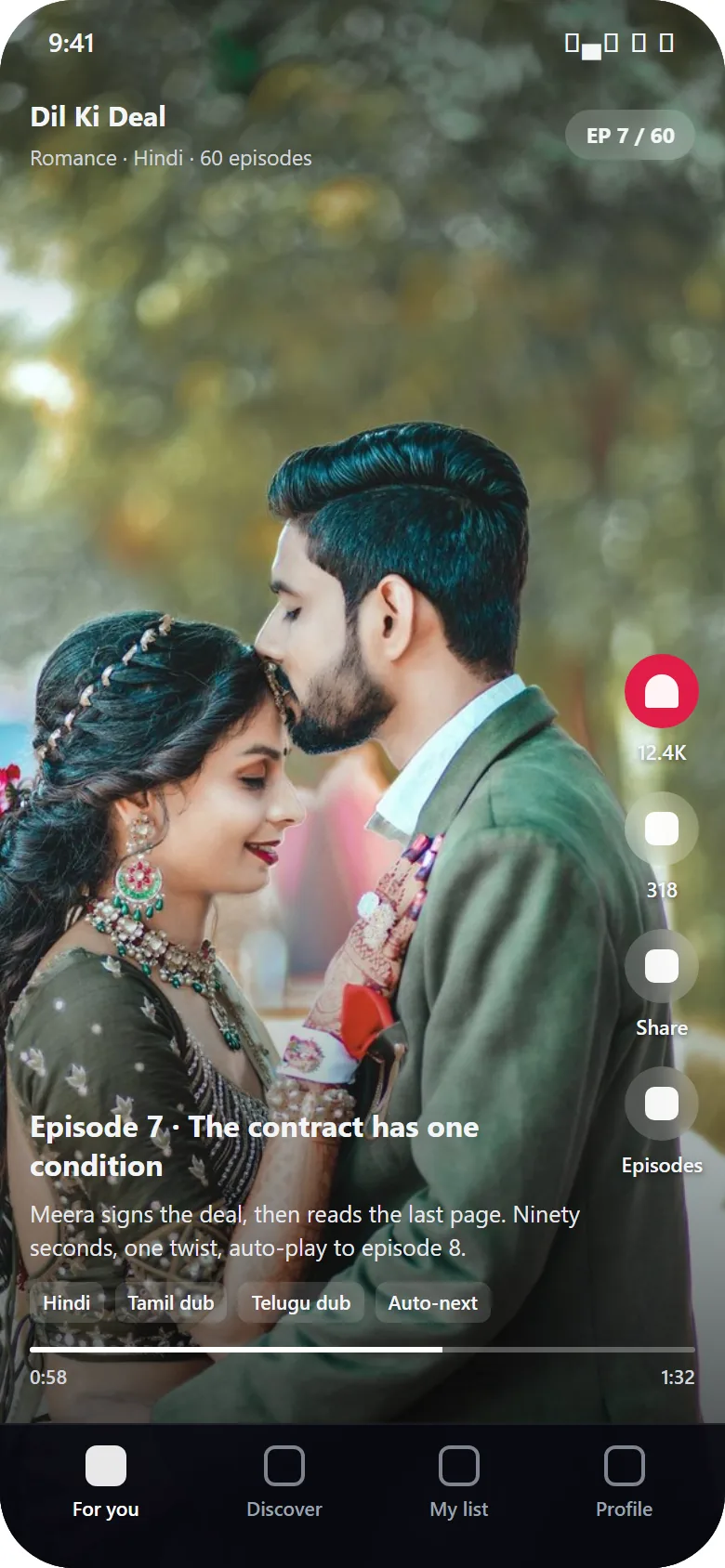
Full-screen 9:16 HLS playback with instant start, swipe to the next episode, auto-next with a countdown, resume position, double-tap like, speed control, picture-in-picture and offline downloads for unlocked episodes.
SpikeSecure builds short drama and micro drama apps for Australian studios, production companies, screen-funded creators and founders from Coimbatore, India, in the format Story TV, ReelShort, DramaBox and Kuku TV made familiar: vertical 1–2 minute episodes with auto-next, a coin wallet with rewarded-ad and season-pass unlocks through store billing priced in AUD, English catalogues, and a studio CMS that drops new episodes daily. Our own product already runs the wallet, payout and moderation stack in production. Fixed-scope AUD proposals, NDA, code in your name.
SpikeSecure Technologies Pvt. Ltd. is a software development company in Coimbatore, India, that builds short drama and micro drama apps for Australian studios, production companies, screen-funded creators and founders remotely. A short drama app (also called a micro drama, vertical drama or duanju app) plays 1–2 minute episodes in a full-screen vertical feed with auto-next, gives the first few episodes free, then unlocks the rest with coins, rewarded ads, season passes or a subscription. A build for Australia covers Android, iOS and web viewer apps, a studio CMS for uploads, dubs, subtitles and scheduled drops, a coin wallet on store billing priced in AUD with Stripe on the web, rewarded-ad verification, recommendations, moderation and analytics down to retention per episode.
What is different from a Australian agency is the cost base and the time-zone shape, not the engineering: our published Indian ranges are the starting point for every AUD proposal, the live overlap is 14:00–17:30 AEST, and the wallet, payout and moderation modules come from our own product, Local Friends, which runs them in production. We have not yet published a short drama client by name, here or in India, and this page says so. Story TV, ReelShort, DramaBox and Kuku TV are named as examples of the format, not as clients.
Full-screen 9:16 HLS playback with instant start, swipe to the next episode, auto-next with a countdown, resume position, double-tap like, speed control, picture-in-picture and offline downloads for unlocked episodes.
Series page with an episode grid showing free, unlocked and locked states; discover feed with a daily drop banner, language and genre chips, ranked rows, search, continue-watching and a my-list shelf; deep links that open a specific episode from ads and social posts.
Coin wallet with packs and bonus tiers priced in AUD, Google Play Billing and App Store in-app purchase in the apps, Stripe for web top-ups with Apple Pay, Google Pay and PayID through your bank where you want it, three-a-day rewarded-ad unlocks, season passes, an ad-free subscription, daily check-in rewards and promo codes, with a paywall position set per series.
Bulk episode upload with transcoding status, thumbnails and covers, scheduled drops at a fixed local time, dubs and subtitles per language (English), paywall rules per series, A/B titles, a moderation queue and revenue-share payouts to partner studios.
For-you ranking on completion rate and genre affinity, cold-start rows for new users, push notifications for new episodes, abandoned-paywall nudges, and email, SMS or WhatsApp re-engagement built with consent.
Retention per episode with the paywall marked, coin spend and ad-unlock funnels, cohort and language views, GA4 and store analytics, and AI moderation of video frames, audio and comments with human review, the pipeline that runs on Local Friends.
Illustrative screens of the viewer app and the studio CMS: the vertical player in the page header, then the series page with its unlock sheet, the discover feed, the coin store and the studio dashboard. Fictional app, series and figures; your build carries your branding, languages and AUD pricing.
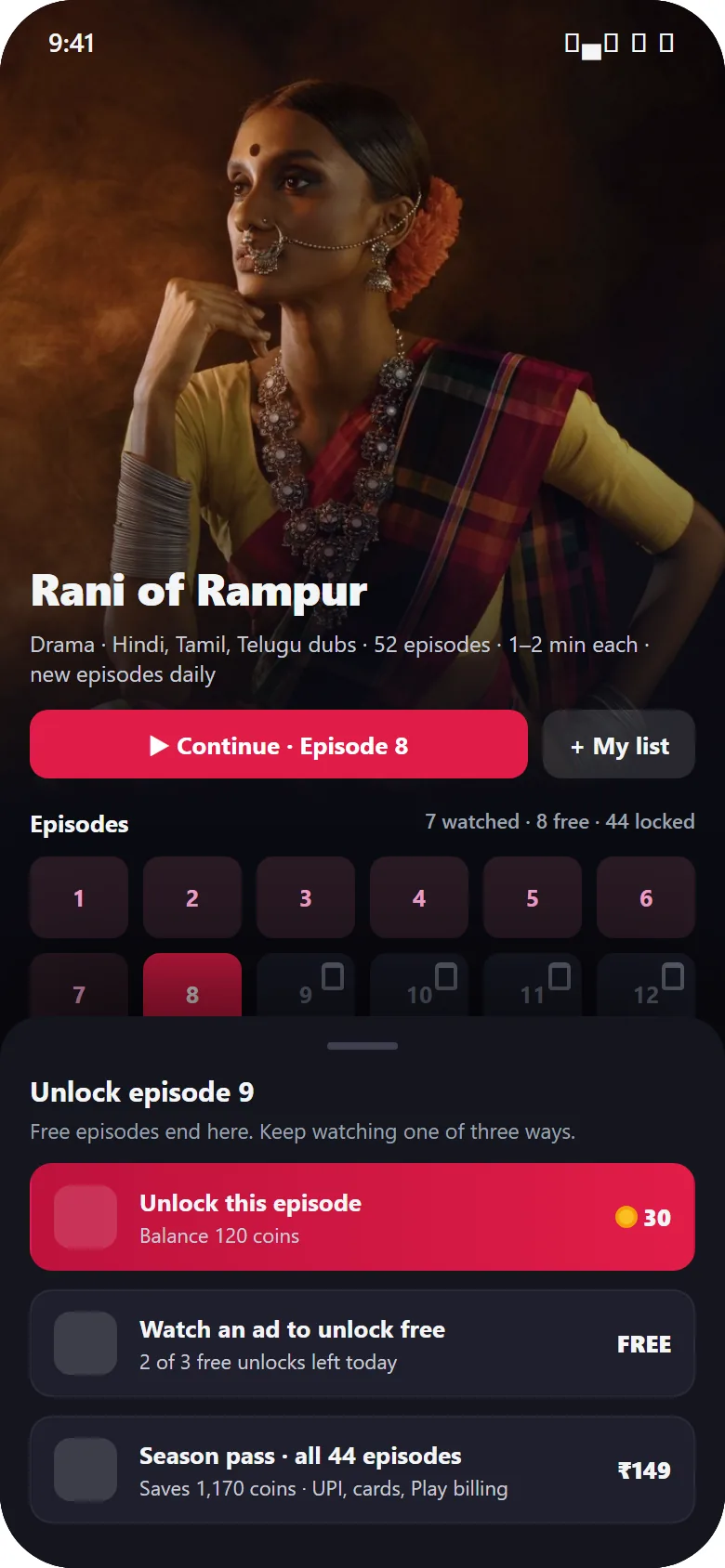
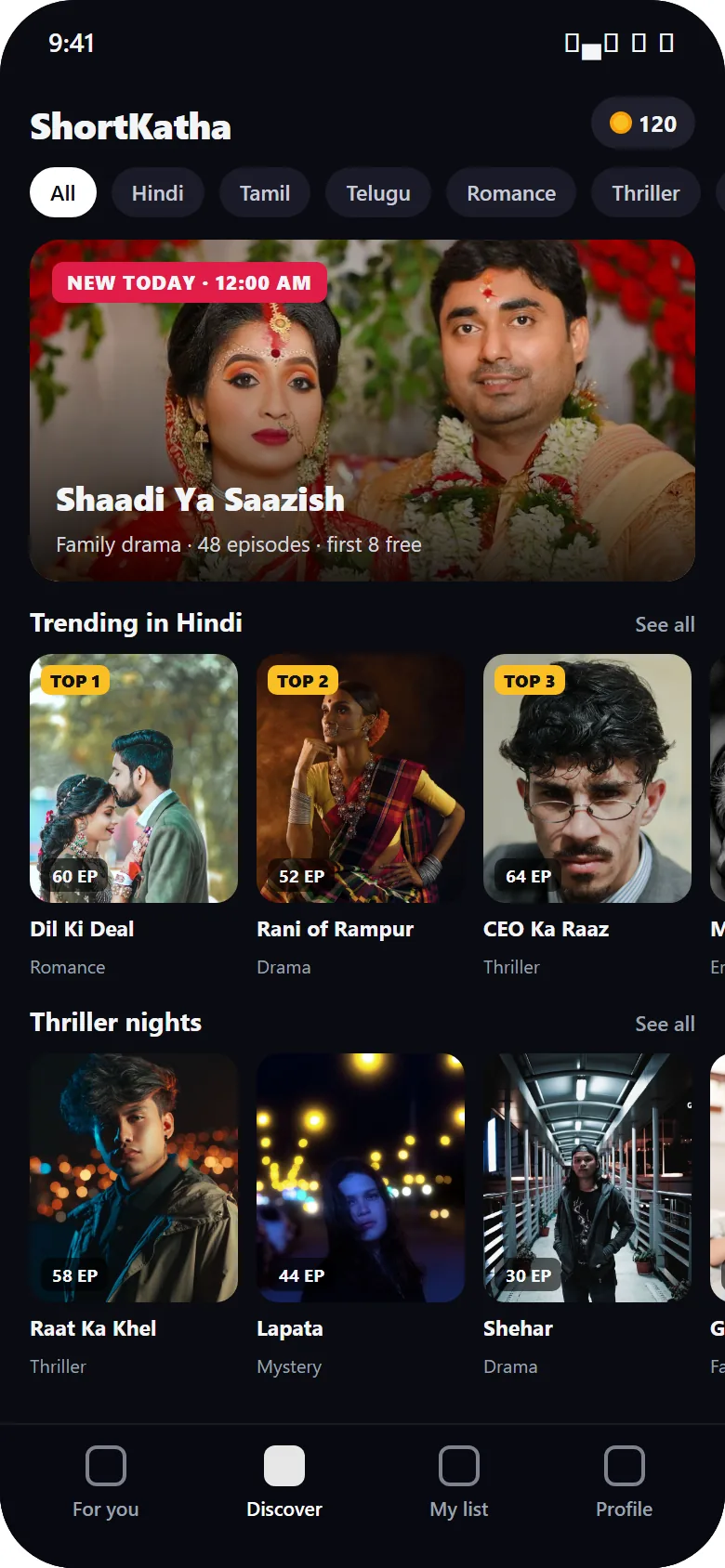
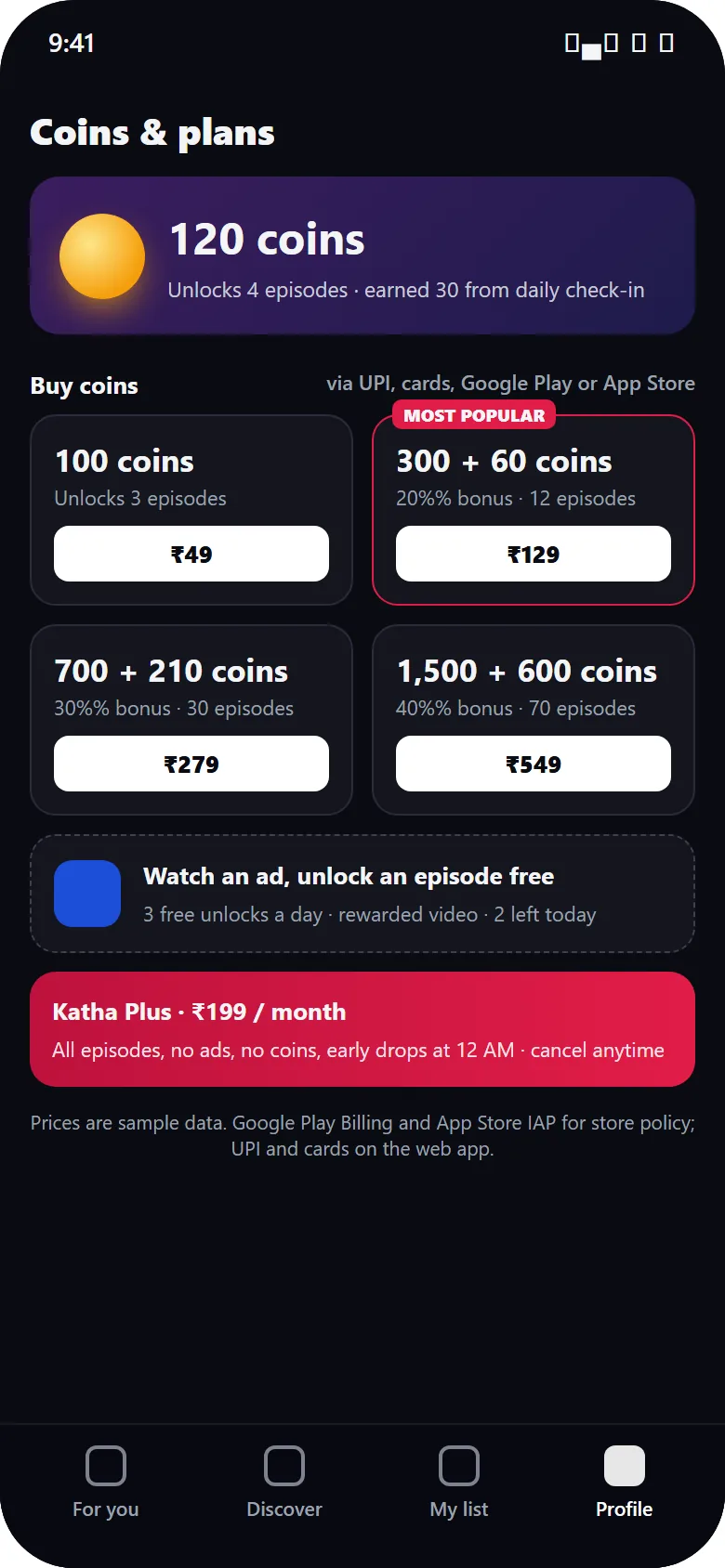
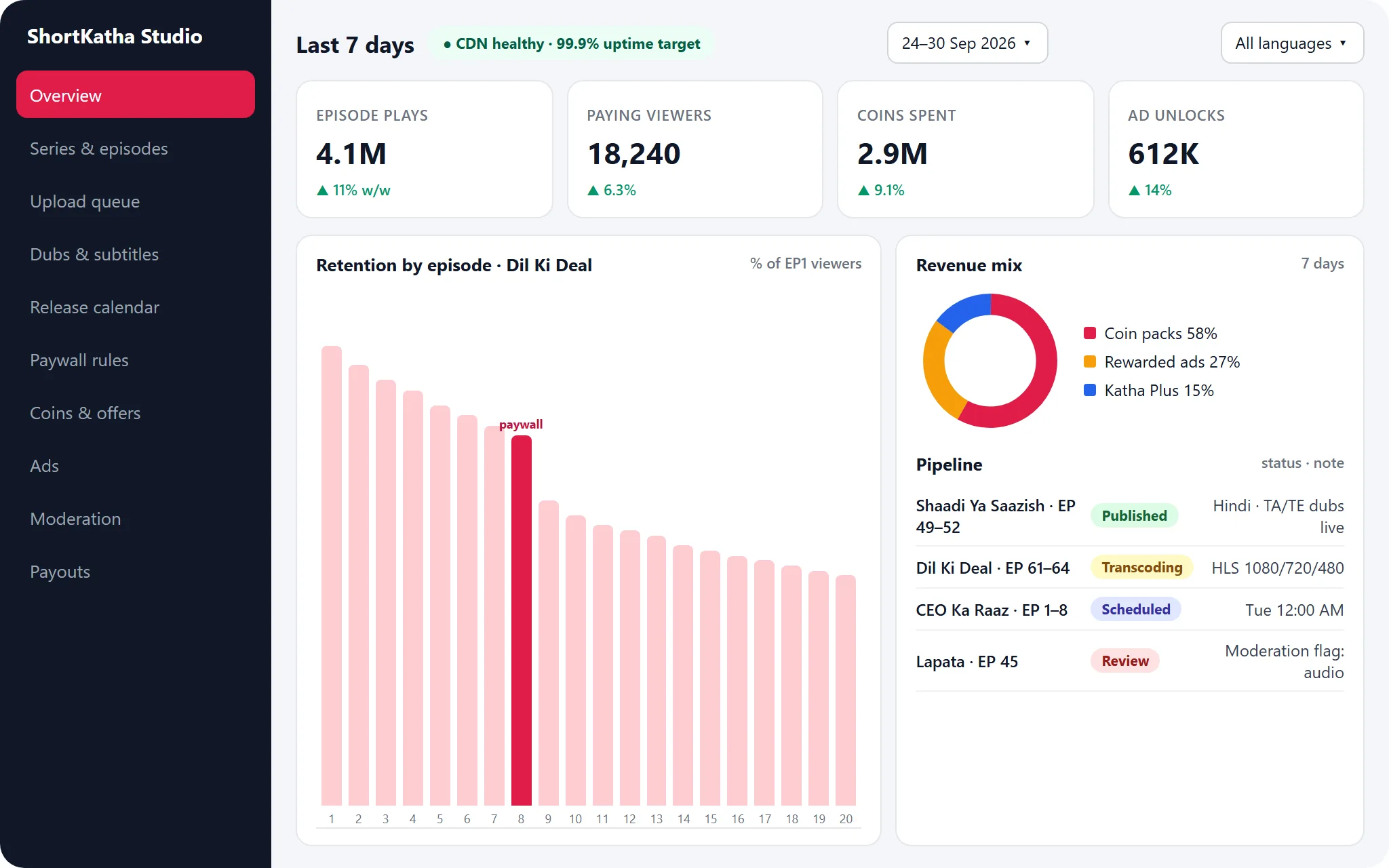
Stills inside the mock-ups are licensed stock photos standing in for episode frames; the app name ShortKatha, the series titles and every number are sample data, not any real app's interface or metrics.
Australia is a high-ARPU, English-first market with a large multicultural audience, so a short drama launch there is usually a catalogue decision (original English series, licensed dubs, or diaspora-language content) before it is a technology decision. The platform decisions that matter are store policy, classification and privacy.
English interfaces and catalogues, with Chinese, Hindi, Punjabi, Vietnamese or Arabic tracks for multicultural audiences. Each episode carries one audio track and one subtitle file per language, with localised store listings and territory rules per series.
Coins and passes unlocked inside the Android and iOS apps go through Google Play Billing and App Store in-app purchase priced in AUD; the web viewer sells the same coins through Stripe for web top-ups with Apple Pay, Google Pay and PayID through your bank where you want it. Rewarded ads use AdMob, Unity or AppLovin with server-side verification before an unlock is granted.
We design for the Privacy Act 1988 and the Australian Privacy Principles (collection notices, access and correction, cross-border disclosure), the Notifiable Data Breaches scheme, the Spam Act for email and SMS consent, WCAG 2.1 AA under the Disability Discrimination Act, PCI DSS scope kept inside Stripe, and Consumer Data Right obligations where you build on Open Banking data, at the time of writing (October 2026). Your counsel signs off; we implement. Content classification and age ratings for the catalogue are scoped with your counsel; the app carries per-series ratings, parental controls and reporting flows.
AWS ap-southeast-2 (Sydney) or ap-southeast-4 (Melbourne), Google Cloud Sydney or Melbourne, or Vercel with a Sydney region, in your accounts with your billing; encrypted Postgres, S3 and a CDN in front. Data stays in Australia unless you choose otherwise. A CDN with Sydney, Melbourne and Perth edges keeps episode start times short.
Flutter apps for Android and iOS plus a web viewer, vertical HLS player with auto-next, series and discover screens, coin wallet with store billing and web top-ups, rewarded-ad unlocks, basic admin for uploads and scheduling, analytics. 10–14 weeks. roughly AUD 12,000–25,000.
Everything in the MVP plus the studio CMS with bulk upload, dubs and subtitles per language, season passes and an ad-free subscription, recommendations, deep links, push and messaging re-engagement, moderation queue, partner payouts and cohort analytics. 16–24 weeks. roughly AUD 25,000–53,000.
Multi-tenant or white-label product for media companies and studios: per-brand apps from one codebase, revenue-share accounting, regional CDN, SSO for partner studios and a phased rollout. 24–36 weeks. From roughly AUD 53,000.
Vertical episode feed, coins and rewarded unlocks added to your current OTT, news or social app on its existing stack, with the wallet ledger and reconciliation you need to close the books. 6–10 weeks. roughly AUD 5,500–14,000.
AUD, invoiced through Stripe or Wise; USD or INR if you prefer. Prices in proposals are fixed in the invoicing currency.
Transcoding and CDN usage billed by the providers in your accounts, store commissions on in-app purchases, ad-network shares, push and messaging charges, cloud hosting, and optional maintenance from ₹20,000 per month (roughly AUD 350) with security patching, SDK and store-policy updates and a monthly health report.
Read how we choose between stacks on the technologies page.
Scheduled around the agreed Australia overlap window; every step is written into the proposal.
We map the catalogue, languages, free-episode count, paywall position, coin pricing in AUD and ad strategy, agree store-policy and Australian compliance scope with your counsel, and send a fixed-scope AUD proposal within 48 hours.
Player, series, paywall, coin store and studio screens as a clickable prototype, tested with real viewers on the first-episode-to-paywall path before any code.
Video pipeline and player first, then wallet, store billing and rewarded ads against sandboxes, then the studio CMS and recommendations, in weekly recorded staging demos with GitHub access from day one.
Your first series loaded through the CMS, dubs and subtitles checked, paywall and refund flows tested on real devices and networks, store-policy review for in-app purchase and rewarded ads.
Store submission in your developer accounts, a limited cohort with daily reconciliation of coins, store receipts and ad unlocks, then the public launch with the first daily drops scheduled in your time zone.
30-day warranty, then maintenance from ₹20,000 per month with security patching, SDK and store-policy updates and a monthly health report on retention and revenue.
SpikeSecure has one office, at CHIL SEZ IT Park, Saravanampatti, Coimbatore, India. Australian clients are served remotely by that engineering team; there is no Australia office, entity or local staff, and we do not claim one.
Our published Indian ranges are ₹7–14 lakh for an MVP, ₹14–30 lakh for a full platform, from ₹30 lakh for a white-label platform and ₹3–8 lakh for a short drama module in an existing app; roughly AUD 12,000–25,000 for the MVP and roughly AUD 25,000–53,000 for a full platform as indicative conversions (roughly ₹57 per Australian dollar). The written AUD proposal fixes the price.
Inside the Android and iOS apps, coins and passes must go through Google Play Billing and App Store in-app purchase. The web viewer can sell the same coins through Stripe for web top-ups with Apple Pay, Google Pay and PayID through your bank where you want it, and the wallet is a single ledger across all three, so a viewer who tops up on the web spends in the app. We build both and keep the stores' rules in scope.
English interfaces and catalogues, with Chinese, Hindi, Punjabi, Vietnamese or Arabic tracks for multicultural audiences. One audio track and one subtitle file per language per episode, language chips in the app and localised store listings; dubbing is done by your studio or a partner, and we integrate AI dubbing APIs where you want a first pass.
We design for the Privacy Act 1988 and the Australian Privacy Principles (collection notices, access and correction, cross-border disclosure), the Notifiable Data Breaches scheme, the Spam Act for email and SMS consent, WCAG 2.1 AA under the Disability Discrimination Act, PCI DSS scope kept inside Stripe, and Consumer Data Right obligations where you build on Open Banking data, at the time of writing (October 2026). Your counsel signs off; we implement. Age ratings per series, parental controls, reporting flows and AI moderation with human review are part of the build.
AWS ap-southeast-2 (Sydney) or ap-southeast-4 (Melbourne), Google Cloud Sydney or Melbourne, or Vercel with a Sydney region, in your accounts with your billing; encrypted Postgres, S3 and a CDN in front. Data stays in Australia unless you choose otherwise. Episodes are transcoded to HLS ladders and served through a CDN with edges near your audience; viewer and wallet data stay in your accounts.
Our office hours of 09:30–18:30 IST are 14:00–23:00 AEST (15:00–00:00 AEDT) and 12:00–21:00 AWST, so Sydney, Melbourne and Brisbane teams have a live overlap from 14:00 to about 17:30 for stand-ups and demos, Perth has most of its afternoon, and morning requests are answered by early afternoon your time. Weekly demos are recorded, a Friday status note lists decisions needed, and urgent production issues are handled outside the window under the maintenance agreement.
We have built and operate the wallet, payout, live video and moderation stack in our own product, Local Friends, and the HLS and DRM pipeline for OTT builds. We have not yet published a short drama client by name, in Australia or in India, and we would rather say so than imply otherwise.
Yes. A vertical episode feed with coins and rewarded unlocks can be added to a Flutter, React Native or native app on its existing backend in 6–10 weeks, with the wallet ledger and reconciliation included, roughly AUD 5,500–14,000 as an indicative conversion of the ₹3–8 lakh range.
In Coimbatore, India. SpikeSecure has no Australia office or entity; your project is delivered remotely under a mutual NDA with weekly recorded demos on a staging URL, GitHub access from day one and a written status note every Friday.
You do. Source code goes into a GitHub organisation in your name; store, cloud, CDN, payment and ad-network accounts are yours from day one; all content and viewer data sit in your own buckets and databases, and the intellectual property in the delivered work is assigned to you on payment.
A 30-minute discovery call and a fixed-scope quote — usually within 48 hours. No deck, no sales theatre.